

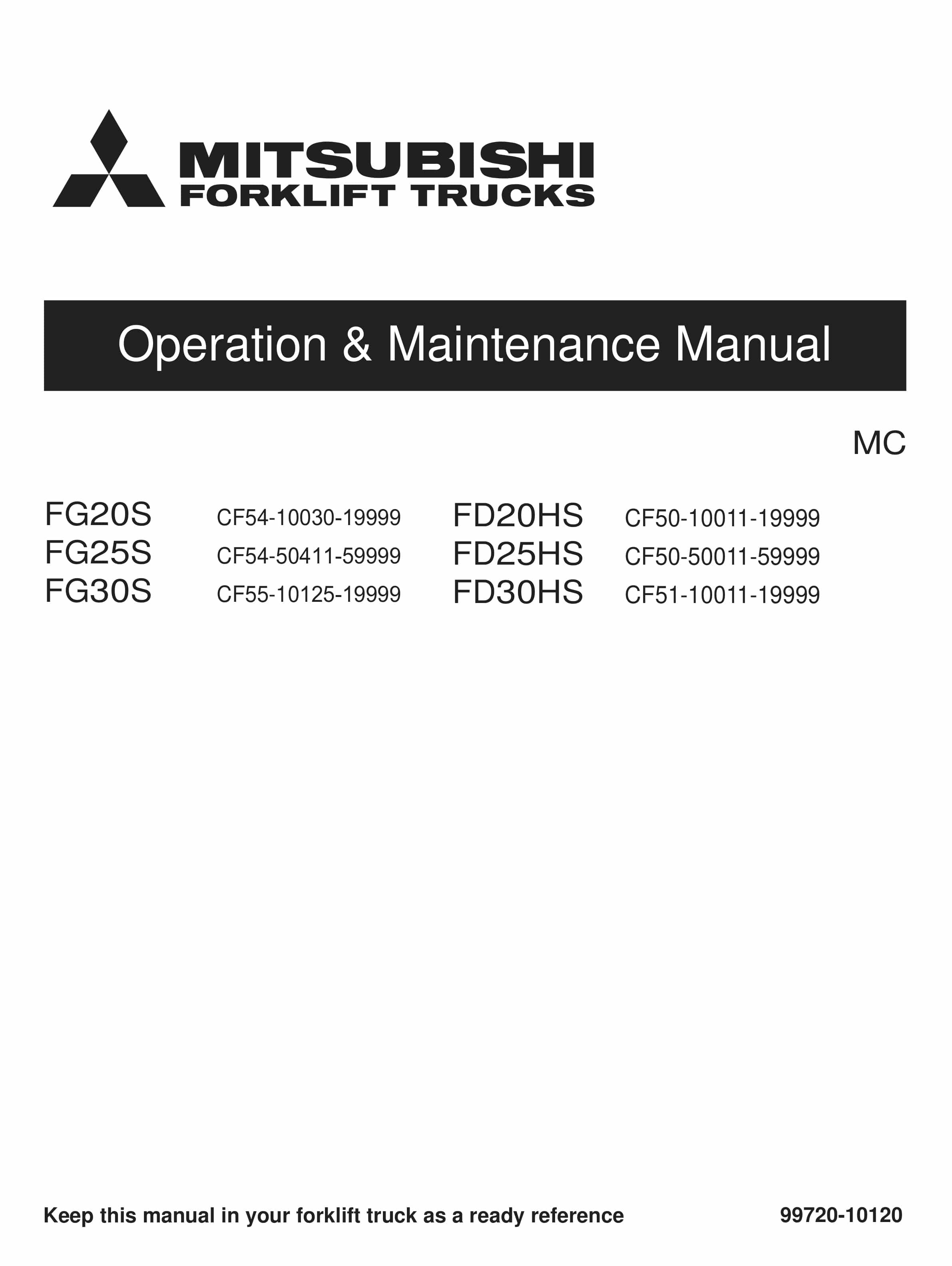
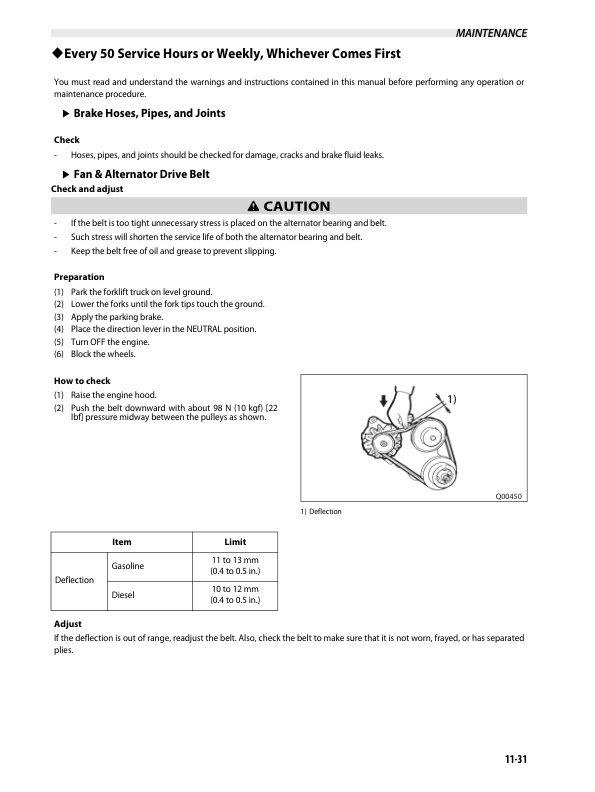
Mitsubishi FG20S-30S, FD20HS-30HS Operation and Maintenance Manual 99720-10120
$30.00
- Type Of Manual: Operation and Maintenance Manual
- Manual ID: 99720-10120
- Number of Pages: 186
- Size: 24.2MB
- Format: PDF
Product details
-
Model List:
- FG20S, FG25S, FG30S, FD20HS, FD25HS, FD30HS
- 1. FOREWORD
- 1.1. How to Use This Manual
- 1.1.1. Truck Models Covered in This Manual
- 1.2. LOCKOUT/TAGOUT
- 2. SAFETY RULES FOR FORKLIFT TRUCK OPERATORS
- 2.1. General
- 2.2. Warning Decals, Location
- 2.3. Warning Decals, Description
- 2.3.1. Survive in a Tipover Decal
- 2.3.2. Tipover Warnings
- 2.3.3. Operation Warning Decal
- 2.3.4. With Overhead Guard Decal / Load Backrest Extension
- 2.3.5. Fuel changeover instructions Decal
- 2.3.6. Parking Brake Decal
- 2.3.7. Cooling Fan
- 2.3.8. Radiator Cap
- 2.3.9. No One under / on Forks / Pinch Points
- 2.3.10. Crush and Pinch Points
- 2.3.11. Capacity Plate
- 2.3.12. No Riders Warning Decal
- 2.3.13. Engine Coolant Decal
- 2.3.14. Deflate Air Before Loosening Nut Decal
- 2.3.15. No Contamination Permissible Decal
- 2.4. Safety Rules
- 2.5. Operating Precautions
- 2.6. Working Precautions
- 3. KNOW YOUR FORKLIFT TRUCK
- 3.1. Serial Number and Capacity Plate
- 3.2. Model View
- 3.2.1. MC Model
- 3.3. Driving Switches and Controls
- 3.3.1. Direction Lever
- 3.3.2. Turn Signal / Light Switch
- 3.3.3. Key Switch
- 3.3.4. Steering Column Tilt Lever
- 3.3.5. Inching Pedal
- 3.4. Meter Panel
- 3.4.1. Warning and Indicator Icons
- 3.4.2. Warning Icons and Indicators
- 3.4.3. Basic Screen Display
- 3.5. Operating Controls
- 3.5.1. Lift Lever
- 3.5.2. Tilt Lever
- 3.6. Operator Seat
- 3.6.1. Seat Adjustment
- 3.6.2. Forward and Back Adjustment
- 3.6.3. Reclining Angle Adjustment
- 3.6.4. Pocket for the Manual
- 3.7. Seat Belt
- 3.8. Engine Hood
- 3.8.1. Hood Latch
- 3.9. Drawbar Pin (Option)
- 4. HOW TO AVOID A TIPOVER HOW TO SURVIVE ONE
- 4.1. Know What Forklift Truck Stability Is
- 4.2. Center of Gravity (CG)
- 4.3. Stability and Center of Gravity
- 4.4. Forklift Truck Stability Base
- 4.5. Capacity (Weight and Load Center)
- 4.6. Capacity Plate
- 4.6.1. For Example
- 4.7. Dos and Donts to Avoid Tipover
- 4.8. How to Survive in a Tipover
- 5. REFUELING
- 5.1. Gasoline and Diesel Engine Equipped
- 5.2. LPG Equipped
- 5.2.1. For Standard LPG Tank
- 6. OPERATION
- 6.1. New Forklift Truck Break-in
- 6.2. Before Starting Engine
- 6.2.1. Assist Grip
- 6.2.2. Starting Engine
- 6.2.3. Gasoline / LPG Dual Fuel Type
- 6.2.4. Instruction for Changeover of Fuel Between LPG and Gasoline
- 6.3. Starting Engine
- 6.3.1. Gasoline Engine Model
- 6.3.2. LPG Engine Model
- 6.3.3. Diesel Engine Model
- 6.4. Engine Wont Start
- 6.4.1. When Engine Is Flooded
- 6.4.2. When Engine Is Started after Long Idle Period
- 6.5. After Starting Engine
- 6.6. Before Moving Forklift Truck
- 6.7. Forklift Truck Operation
- 6.7.1. Changing Speed
- 6.7.2. Changing Direction
- 6.7.3. Operating Techniques
- 6.7.4. Steering (Turning)
- 6.7.5. Inching
- 6.8. Stopping Forklift Truck
- 6.9. Parking Forklift Truck (After Stopping)
- 7. OPERATING TECHNIQUES
- 7.1. Stacking Methods
- 7.1.1. Stacking Different Loads in Size
- 7.1.2. Stacking Small Identical Loads
- 7.1.3. Stacking Large Identical Loads
- 7.2. Handling Loads Safely
- 7.2.1. Fork Spread Adjustment
- 7.3. Inching Into and Lifting the Load
- 7.4. Traveling with the Load
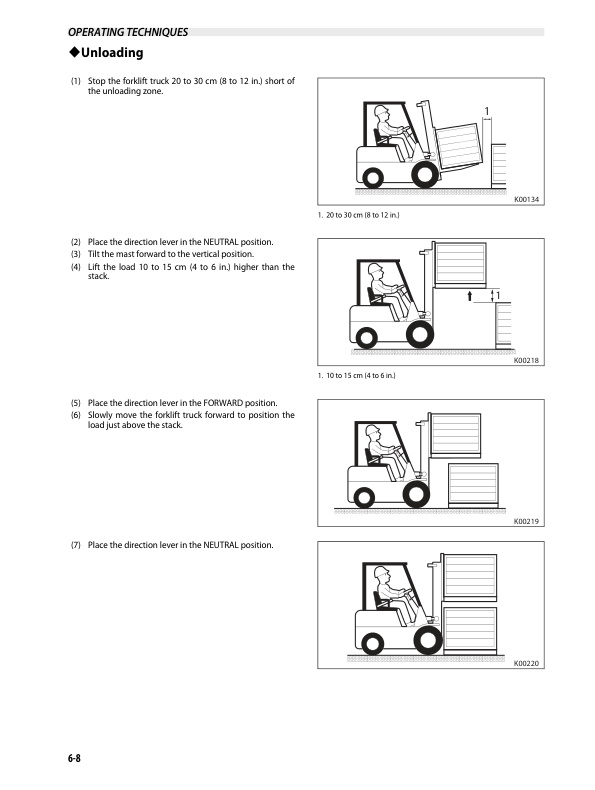
- 7.5. Unloading
- 7.6. Working on Grades
- 7.6.1. Normal Travel Position
- 7.6.2. Traveling on a Grade
- 7.6.3. Stopping on a Grade
- 7.6.4. Starting on a Grade (Engine Stalls on a Grade)
- 8. STORING THE FORKLIFT TRUCK
- 8.1. End of Each Shift Storage
- 8.2. Long Term Storage
- 8.2.1. Storage within 3 Months
- 8.2.2. Storage Exceeding 3 Months
- 9. TRANSPORTATION HINTS
- 9.1. Forklift Truck Loading and Shipping
- 9.2. Forklift Truck Lifting and Tiedown Information
- 10. SPECIAL SITUATIONS
- 10.1. Care in Cold Weather
- 10.1.1. Fuel Oils and Lubrication Oils
- 10.1.2. Battery
- 10.1.3. Engine Coolant
- 10.2. Care in Hot Weather
- 10.2.1. Fuel Oils and Lubrication Oils
- 10.2.2. Battery
- 10.2.3. Engine Coolant
- 10.3. Severe Dust or Lint Conditions
- 10.3.1. Air Cleaner Element
- 10.3.2. Engine Oil and Engine Oil Filter
- 10.3.3. Hydraulic Oil
- 10.3.4. Hydraulic Tank Return Filter
- 11. TROUBLESHOOTING
- 11.1. If a Tire Blows Out
- 11.1.1. If a Tire Blows out During Traveling or Operation
- 11.2. Replacing Tires
- 11.2.1. Before Replacing Tires
- 11.2.2. To Remove Wheel
- 11.2.3. To Raise Front Wheel
- 11.2.4. To Raise Rear Wheel
- 11.2.5. To Install Wheel
- 11.2.6. To Add Air to Tires
- 11.3. Stalled Engine
- 11.3.1. Before Starting the Engine Again
- 11.4. If the Water temperature warning icon glows
- 11.5. Trouble with the LPG Equipment
- 11.6. Starting with Jumper Cables
- 11.7. If Lights Wont Glow
- 11.7.1. How to Check Fuses and Lights
- 11.8. If the Forklift Truck Wont Change Directions
- 11.9. If the Mast Stops Moving
- 12. MAINTENANCE
- 12.1. General
- 12.2. Inspection Precautions
- 12.3. Maintenance Schedule
- 12.3.1. Every 10 Service Hours or Daily (Pre-Start), Whichever Comes First
- 12.3.2. Every 50 Service Hours or Weekly, Whichever Comes First
- 12.3.3. One Month (30 days) or 200 Service Hours after Delivery of a New Truck, Whichever Comes First
- 12.3.4. Every 500 Service Hours or 3 Months, Whichever Comes First
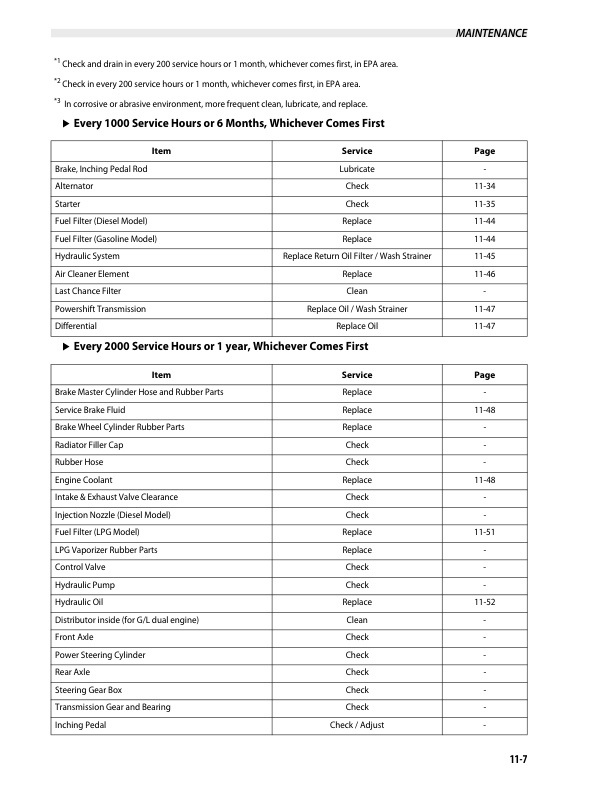
- 12.3.5. Every 1000 Service Hours or 6 Months, Whichever Comes First
- 12.3.6. Every 2000 Service Hours or 1 year, Whichever Comes First
- 12.4. Every 10 Service Hours or Daily (Pre-Start), Whichever Comes First
- 12.4.1. Faulty Operation Found the Day Before
- 12.4.2. Oil, Fuel or Coolant Leaks
- 12.4.3. Fuel Cap
- 12.4.4. Tires and Rims
- 12.4.5. Wheel Nuts
- 12.4.6. Tire Pressure
- 12.4.7. Lights and Lens
- 12.4.8. Assist Grip
- 12.4.9. Overhead Guard
- 12.4.10. Mast and Forks
- 12.4.11. Load Backrest Extension
- 12.4.12. Lift Chains
- 12.4.13. Mast and Lift Bracket
- 12.4.14. Lift Cylinder Mounting Bolts
- 12.4.15. Tilt Cylinder Socket Bolts
- 12.4.16. Lift and Tilt Cylinder
- 12.4.17. Battery
- 12.4.18. Engine Coolant
- 12.4.19. Engine Oil
- 12.4.20. Engine Cooling Fan
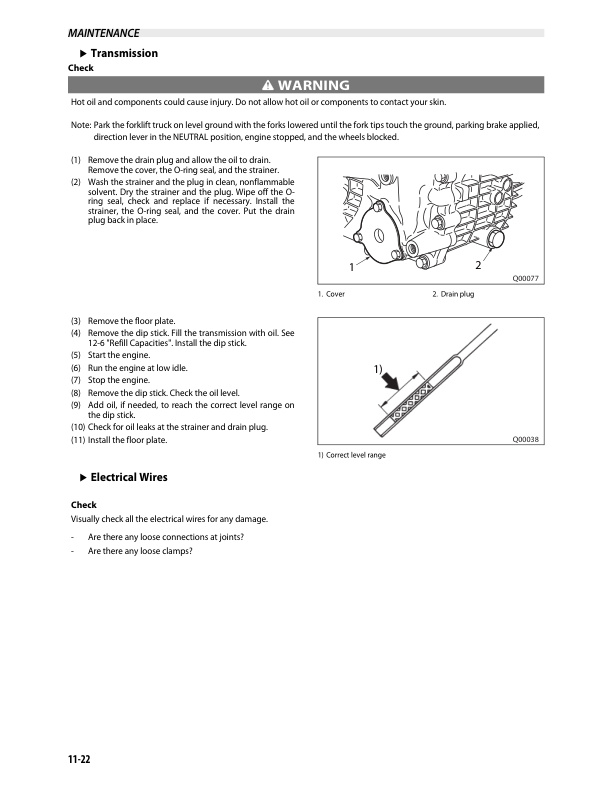
- 12.4.21. Transmission
- 12.4.22. Electrical Wires
- 12.4.23. Hydraulic Oil
- 12.4.24. Operator Seat
- 12.4.25. Steering Column
- 12.4.26. Steering Wheel
- 12.4.27. Service Brakes
- 12.4.28. Parking Brake Lever
- 12.4.29. Brake Pedal
- 12.4.30. Inching Pedal
- 12.4.31. Accelerator Pedal
- 12.4.32. Seat Belt
- 12.4.33. Head Light and Working Light
- 12.4.34. Turn Signal Light
- 12.4.35. Stop Lights (Option)
- 12.4.36. Backup Lights (Option)
- 12.4.37. Icons of Meter Panel
- 12.4.38. Meter Panel
- 12.4.39. Engine (Exhaust, Noise, and Vibration)
- 12.4.40. Mast Strip Sliding Surfaces
- 12.4.41. Brake Pedal
- 12.4.42. Steering Wheel
- 12.4.43. After the Daily (Pre-Start) Inspection
- 12.5. Every 50 Service Hours or Weekly, Whichever Comes First
- 12.5.1. Brake Hoses, Pipes, and Joints
- 12.5.2. Fan Alternator Drive Belt
- 12.5.3. Hydraulic Hoses, Pipes, and Joints
- 12.5.4. Air Cleaner Element
- 12.6. One Month (30 days) or 200 Service Hours after Delivery of a New Truck, Whichever Comes First
- 12.6.1. Radiator Filler Cap
- 12.6.2. Radiator Rubber Hose
- 12.6.3. Alternator
- 12.6.4. Starter
- 12.6.5. Cylinder Head Bolt Manifold Nut
- 12.6.6. Electrical Wires
- 12.6.7. Intake Exhaust Valve
- 12.6.8. Engine Oil
- 12.6.9. Bolts and Nuts (Frame Chassis)
- 12.6.10. Fuel Filter (Diesel Model)
- 12.6.11. Fuel Filter (Gasoline Model)
- 12.6.12. Hydraulic Tank Return Oil Filter
- 12.6.13. Mast Support
- 12.6.14. Tilt Socket Pins
- 12.6.15. King Pins
- 12.6.16. Tie Rod Pins
- 12.7. Every 500 Service Hours or 3 Months, Whichever Comes First
- 12.7.1. Radiator Fin
- 12.7.2. Battery
- 12.7.3. Engine Idle Speed (for G/L dual engine)
- 12.7.4. Engine Oil
- 12.7.5. Bolts, Nuts (Frame Chassis)
- 12.7.6. Tar in Vaporizer
- 12.7.7. Fuel Filter (LPG Model)
- 12.7.8. Spark Plug
- 12.7.9. Lift Chains
- 12.7.10. Mast Support
- 12.7.11. Tilt Socket Pins
- 12.7.12. Mounting Bush of Rear Axle
- 12.7.13. King Pins
- 12.7.14. Tie Rod Pins
- 12.7.15. Differential
- 12.8. Every 1000 Service Hours or 6 Months, Whichever Comes First
- 12.8.1. Alternator
- 12.8.2. Starter
- 12.8.3. Cylinder Head Bolt Manifold Nut
- 12.8.4. Fuel Filter (Diesel Model)
- 12.8.5. Fuel Filter (Gasoline Model)
- 12.8.6. Hydraulic System
- 12.8.7. Air Cleaner Element
- 12.8.8. Powershift Transmission
- 12.8.9. Differential
- 12.9. Every 2000 Service Hours or 1 Year, Whichever Comes First
- 12.9.1. Service Brake Fluid
- 12.9.2. Engine Coolant
- 12.9.3. Fuel Filter (LPG Model)
- 12.9.4. Hydraulic Oil
- 12.9.5. Parts to Be Changed Periodically
- 13. SERVICE DATA
- 13.1. Fuel Information
- 13.1.1. Gasoline (Gas) Specification
- 13.1.2. Diesel Fuel Specifications
- 13.1.3. Liquefied Petroleum (LPG Model)
- 13.2. Coolant Information
- 13.2.1. Coolant Water
- 13.2.2. Antifreeze Solution
- 13.3. Recommended Fuels and Oils
- 13.4. Specifications (Standard Models)
- 13.5. Refill Capacities
- 13.6. Capacities and Forklift Truck Weight (Standard Models)
- 14. TO THE MITSUBISHI FORKLIFT TRUCK OWNER
- 14.1. The Importance of Genuine Parts
- 14.2. Instructions for Ordering Parts
- 14.3. Service Registration
Related products
-
Mitsubishi ESR, EDR, ESS Operation and Maintenance Manual WEBU6685-01
$30.00 Add to cart -
Mitsubishi FB16N, FB18N, FB20CN Forklift Trucks Operation and Maintenance Manual 99750-56100
$30.00 Add to cart -
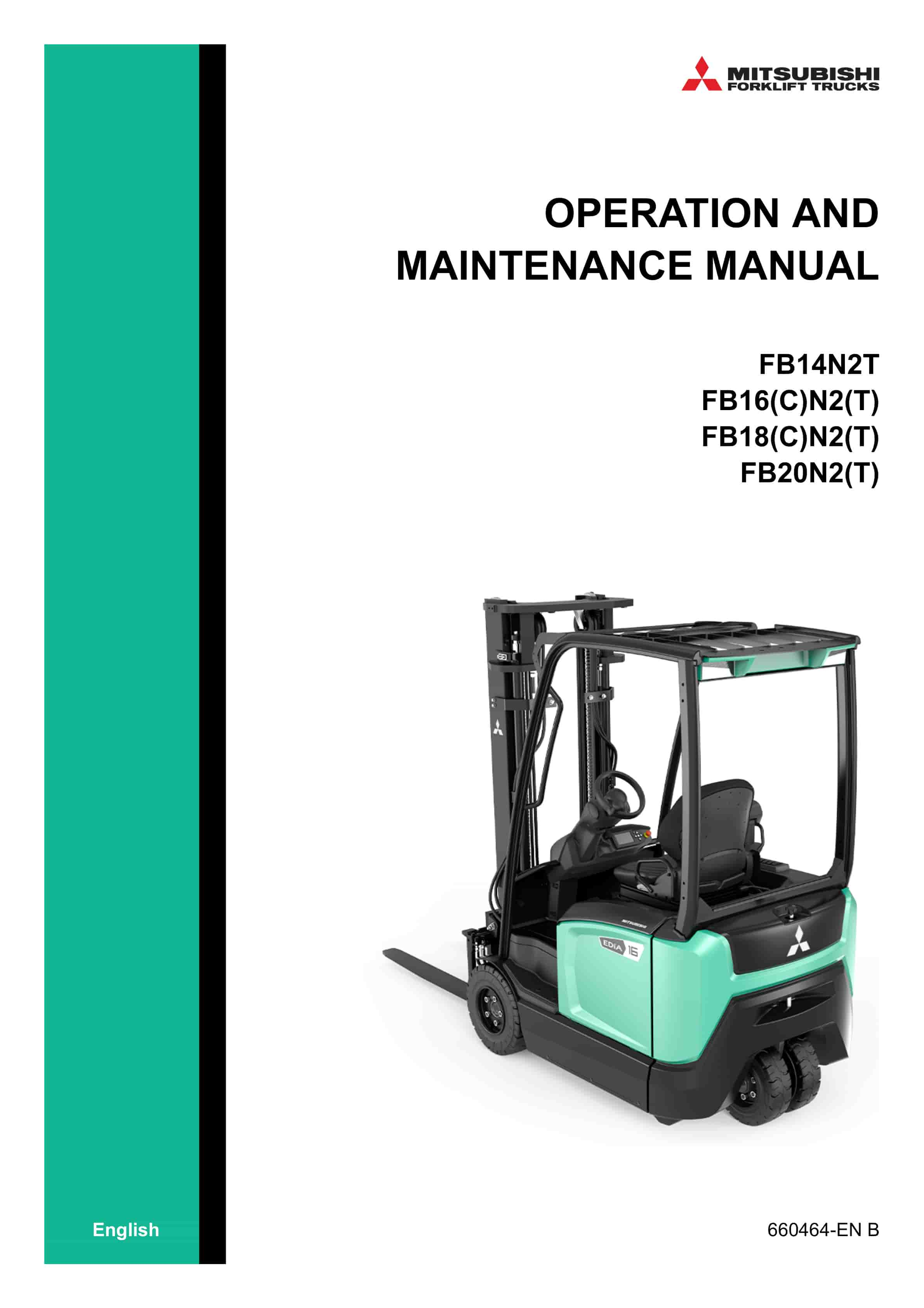
Mitsubishi FB14N2T, FB16(C)N2(T), FB18(C)N2(T), FB20N2(T) Operation and Maintenance Manual 660464 EN B
$30.00 Add to cart -
Mitsubishi FB10K RT, FB12K RT, FB15K RT Forklift Trucks Operation and Maintenance Manual 99750-54110
$30.00 Add to cart -
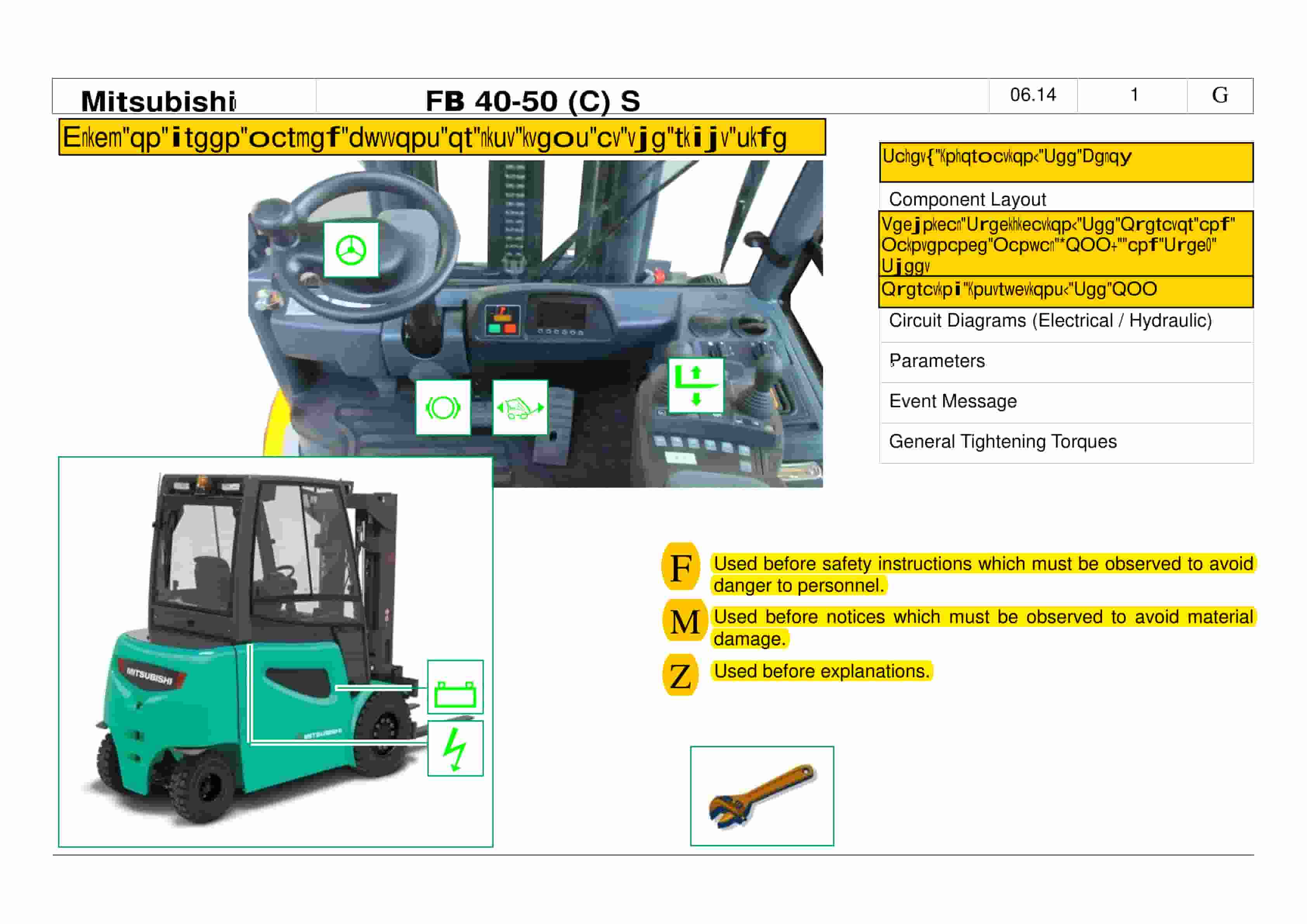
Mitsubishi FB 40-50 (C) S Operating and Maintenance Instructions
$30.00 Add to cart


N2(T),%20FB18(C)N2(T),%20FB20N2(T)%20Operation%20and%20Maintenance%20Manual%20660464%20EN%20B&url=https://ownersmanualpdf.net/docs/mitsubishi-fb14n2t-fb16cn2t-fb18cn2t-fb20n2t-operation-and-maintenance-manual-660464-en-b/&media=https://ownersmanualpdf.net/wp-content/uploads/2025/10/mitsubishi-fb14n2t-fb16cn2t-fb18cn2t-fb20n2t-operation-and-maintenance-manual-660464-en-b-1.jpg)

%20S%20Operating%20and%20Maintenance%20Instructions&url=https://ownersmanualpdf.net/docs/mitsubishi-fb-40-50-c-s-operating-and-maintenance-instructions/&media=https://ownersmanualpdf.net/wp-content/uploads/2025/10/mitsubishi-fb-40-50-c-s-operating-and-maintenance-instructions-1.jpg)