

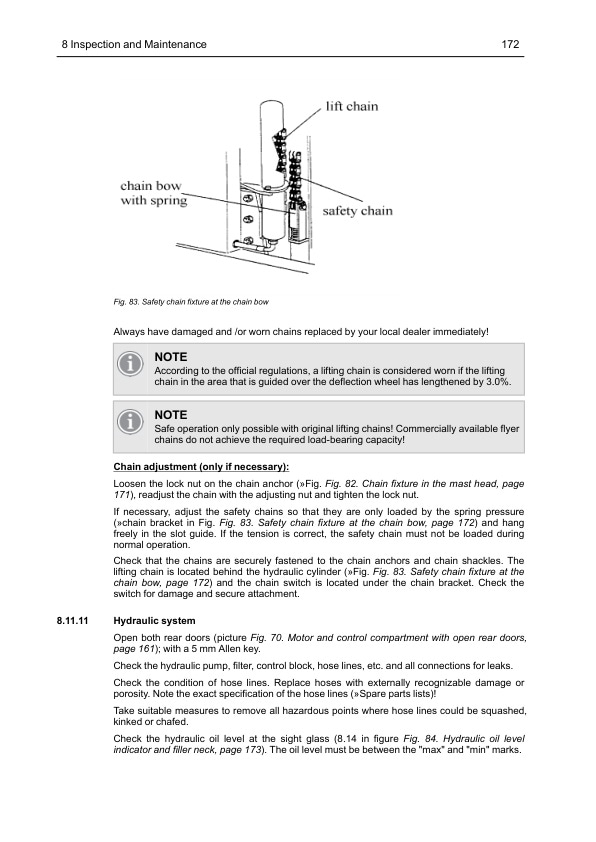
Mitsubishi VNT11 to VNT20 Service Manual SM23GBVNA1A1
$50.00
- Type Of Manual: Service Manual
- Manual ID: SM23GBVNA1A1
- Number of Pages: 222
- Size: 19.0MB
- Format: PDF
Product details
-
Model List:
- VNT11, VNT12, VNT13, VNT14, VNT15, VNT15XL, VNT20
- 1. INTRODUCTION
- 1.1. Contact details
- 1.2. Scope of validity of this operation manual
- 1.2.1. Topicality of this operation manual and/or revisions
- 1.2.2. Scope of this documentation
- 1.3. Guarantee
- 1.3.1. Guarantee according to the General Conditions
- 1.3.2. Limitation of liability
- 1.4. Content of this operation manual
- 1.4.1. Enclosures to this operation manual
- 1.4.2. Subdivision and identification
- 1.5. Safety notes/rating plate
- 1.5.1. Safety decals/symbols on the machine
- 1.5.2. Rating plate and load capacity plate
- 1.5.3. Key to symbols
- 1.5.4. Formula letter symbols
- 1.6. Supplementary documentation
- 2. HEALTH AND SAFETY REGULATIONS, ENVIRONMENTAL PROTECTION
- 2.1. Laws, Decrees, Directives
- 2.2. Basic safety rules
- 2.2.1. Responsibility of the operating authority
- 2.2.2. Tasks and responsibilities of the operating personnel
- 2.2.3. Qualification of the operating personnel
- 2.3. Risks/ Residual dangers
- 2.3.1. Dangers during unloading
- 2.3.2. Dangers when preparing operation
- 2.3.3. Dangers during operation
- 2.3.4. Dangers during maintenance work
- 2.3.5. Dangers during repair work
- 2.3.6. Dangers due to change of the truck
- 2.4. Disposal and environmental protection
- 2.5. Safety devices on the industrial truck
- 3. TECHNICAL DATA
- 3.1. Order data
- 3.2. Changes to the vehicle
- 4. UNLOADING, IN-PLANT TRANSPORT
- 4.1. Safety notes
- 4.2. Use of lifting gear for in-plant transport
- 4.2.1. Transport and unloading of the truck
- 4.2.2. Packaging and preservation
- 4.2.3. Completeness of delivery
- 4.3. Treatment of transport damage
- 4.4. Temporary storage
- 4.5. Requirements for the floor in the narrow aisle
- 5. FUNCTIONS AND DESCRIPTION OF THE TRUCK
- 5.1. Use of the industrial truck
- 5.1.1. Intended conditions of use
- 5.1.2. Non-intended conditions of use
- 5.1.3. Safety notes
- 5.2. Functions of the industrial truck
- 5.2.1. Travel function
- 5.2.2. Lift functions
- 5.2.3. Functional criteria
- 5.3. Description of the industrial truck
- 5.3.1. Safety devices on the truck, safety interlocks
- 5.3.2. Chassis and wheels
- 5.3.3. Operators cabin
- 5.3.4. Control panel with indicators and controls
- 5.3.5. Travel drive
- 5.3.6. Steering
- 5.3.7. Brakes
- 5.3.8. Lift unit
- 5.3.9. Attachment and load picking unit
- 5.4. Options or equipment
- 5.5. Guidance systems
- 5.5.1. Mechanical guidance
- 5.5.2. Wire guidance
- 5.6. Safety interlocks
- 5.6.1. Safety interlocks for speed reduction and/or height limitations outside narrow aisles
- 5.6.2. Safety interlocks for speed reduction and/or height limitations in narrow aisles with guidance systems
- 5.6.3. Safety interlocks according to truck position and travel movement in narrow aisles
- 5.7. Description of the control panel
- 5.7.1. Control panel with rotary switches or ball handle bar
- 5.7.2. Control panel with multi-function lever
- 5.7.3. Control panel with single levers
- 5.7.4. Explanations to the console switches, symbols
- 6. PREPARING THE TRUCK FOR OPERATION
- 6.1. Safety notes
- 6.1.1. Ambient conditions
- 6.1.2. Condition of travel routes
- 6.1.3. Packaging and preservation
- 6.2. Checks before initial use/after repairs
- 6.2.1. Safety devices
- 6.2.2. Absence of emissions
- 6.2.3. Chassis and wheels
- 6.2.4. Lift unit
- 6.2.5. Attachment
- 6.3. Daily sight checks when the truck is stopped/out of operation
- 6.3.1. Safety devices
- 6.3.2. Absence of emissions
- 6.3.3. Chassis
- 6.3.4. Drive System
- 6.3.5. Lift unit
- 6.3.6. Attachment/load picking unit
- 6.4. Daily inspections and performance checks on the truck ready for operation
- 6.4.1. Safety devices
- 6.4.2. Operators cabin
- 6.4.3. Controls
- 6.4.4. Battery status
- 6.4.5. Steering
- 6.4.6. Brakes
- 6.4.7. Hydraulic functions
- 6.5. Daily inspections of the safety interlocks
- 6.5.1. Components of safety interlocks on the truck
- 6.5.2. Components of safety inter-locks in the warehouse
- 6.6. Check list Pre-start sight/safety checks
- 6.6.1. Checks when the truck is turned OFF
- 6.6.2. Checks when the truck is turned ON
- 7. START-UP, OPERATING AND SHUTDOWN PROCEDURES
- 7.1. Safety notes
- 7.1.1. Safety devices
- 7.1.2. Instructions for the operating crew
- 7.2. Start-up
- 7.3. Operation
- 7.3.1. Operators seat and control panel
- 7.3.2. Emergency STOP push-button
- 7.3.3. Steering/Steering indicator
- 7.3.4. Brakes
- 7.4. Travel drive
- 7.4.1. Running in instructions
- 7.4.2. Travel outside narrow aisles
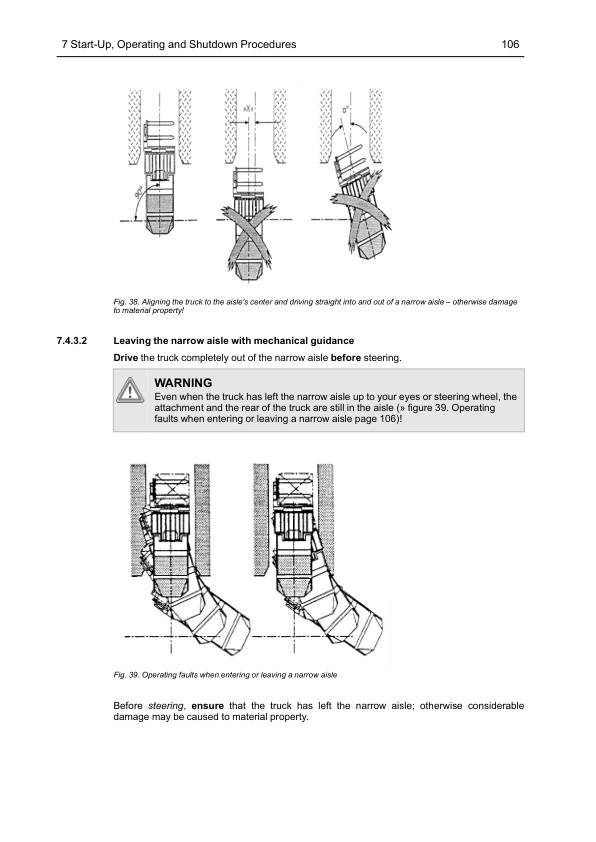
- 7.4.3. Guided travelling inside the narrow aisles
- 7.4.4. Towing the truck
- 7.5. Lifting and lowering
- 7.5.1. Lifting and lowering the operators cabin outside the narrow aisle
- 7.5.2. Lifting and lowering the operators cabin inside the narrow aisle
- 7.5.3. Operation of the attachment/load picking unit
- 7.6. Picking up load
- 7.6.1. Load capacity plate
- 7.6.2. Adjusting the fork spread
- 7.6.3. Picking up a load with the load picking unit
- 7.6.4. Depositing a load
- 7.7. Shutdown and preservation procedures
- 7.7.1. Stopping and parking the truck
- 7.7.2. Preservation for up to 3 months
- 7.7.3. Decommissioning
- 8. INSPECTION AND MAINTENANCE
- 8.1. Safey note
- 8.1.1. Instructing the maintenance personnel
- 8.1.2. Qualification of the maintenance personnel
- 8.1.3. Recurring safety inspections according FEM-4.004
- 8.2. Technical data on maintenance/repair work
- 8.2.1. Lubricants
- 8.2.2. Screw torques
- 8.2.3. Required Materials
- 8.3. Inspection, cleaning, care
- 8.3.1. Inspection
- 8.3.2. Cleaning and Care
- 8.4. General remarks on service and maintenance work
- 8.4.1. Wear or damage to components
- 8.4.2. Checking rubber and plastic parts
- 8.4.3. Screwed connections
- 8.5. Safety measures, preparatory work
- 8.5.1. Securing the lifted mast and/or attachment
- 8.5.2. Opening aggregate compartments
- 8.6. Maintenance work as required
- 8.6.1. Lubrication
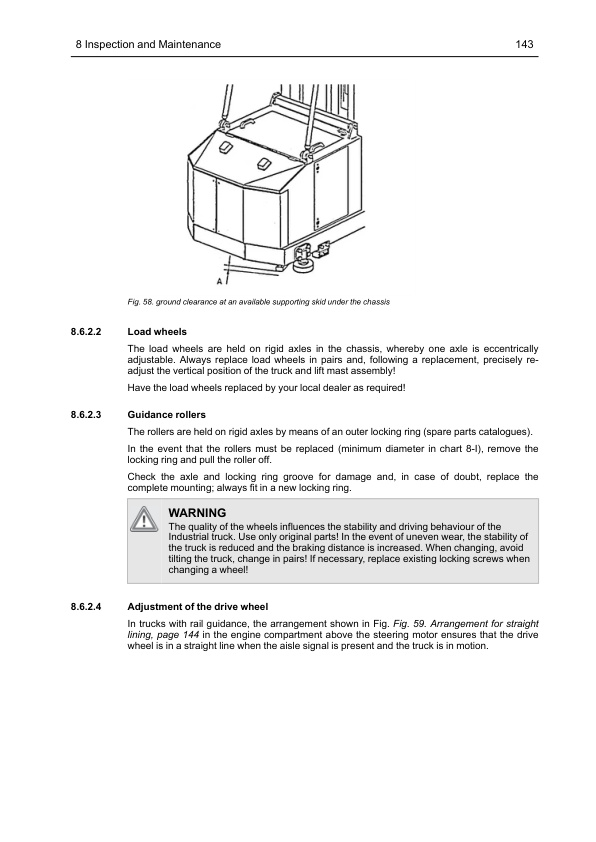
- 8.6.2. Changing wheels
- 8.6.3. Handling the battery
- 8.7. Inspections/maintenance list
- 8.8. Inspection and maintenance work during the first operating hours
- 8.8.1. After 8 operating hours
- 8.8.2. After 25 operating hours
- 8.8.3. After 50 operating hours
- 8.9. Inspection and maintenance DAILY or every 8-10 operating hours
- 8.9.1. Visual Control
- 8.9.2. Battery
- 8.9.3. Wire guidance
- 8.10. Inspection and maintenance work MONTHLY or every 80 operating hours
- 8.10.1. Chassis and wheels
- 8.10.2. Battery
- 8.10.3. Hydraulic system
- 8.10.4. Attachment
- 8.11. Inspection and maintenance work half-yearly or every 500 operating hours
- 8.11.1. Software update
- 8.11.2. Operators cabin
- 8.11.3. Emergency lowering device
- 8.11.4. Chassis and wheels
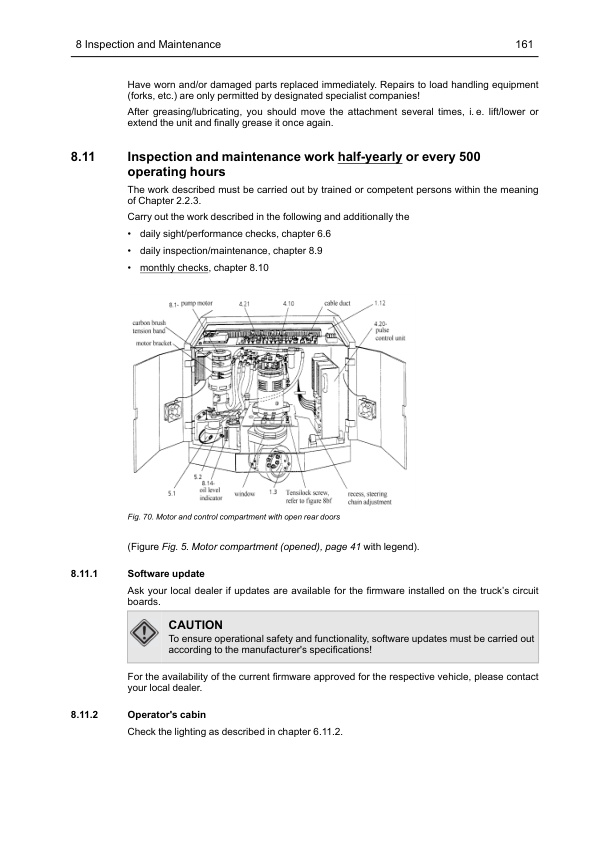
- 8.11.5. Engine Compartment
- 8.11.6. Battery
- 8.11.7. Electrical system
- 8.11.8. Steering
- 8.11.9. Lift unit
- 8.11.10. Hydraulic system
- 8.11.11. Attachment
- 8.11.12. Wire Guidance
- 8.12. Inspection and maintenance work YEARLY or every 1000 operating hours
- 8.12.1. Safety circuits
- 8.12.2. Battery
- 8.12.3. Drive unit
- 8.12.4. Hydraulic system
- 8.12.5. Attachment
- 8.13. Inspection and maintenance work EVERY 2 YEARS or every 2,000 operating hours
- 8.13.1. Drive unit
- 8.13.2. Electrical system
- 9. FUNCTIONAL DISORDERS, THEIR CAUSES AND RECTIFICATION
- 9.1. Causes for functional disorders
- 9.2. Trouble shooting
- 9.3. Customer service
- 9.4. Error messages on the display
- 9.5. Check list functional disorders
- 9.5.1. Truck does not start
- 9.5.2. Truck does not drive
- 9.5.3. Truck reduces travel speed autonomously
- 9.5.4. Truck stops during operation
- 9.5.5. Truck does not (re)start
- 9.5.6. Steering does not work
- 9.5.7. Lifting/Lowering does not work
- 9.5.8. Truck does not lower completely
- 9.5.9. Truck does not perform diagonal travelling
- 9.5.10. Unusual operating noise, unsteady operation
- 9.5.11. Functional disorders of the hydraulic system
- 10. APPENDIX TO THESE OPERATING INSTRUCTIONS
- 10.1. Applicable documents
- 10.2. List of abbreviations, definitions and terms
- 11. OPTIONS
- 11.1. Cold store operation
- 11.2. Position Assistance System
- 11.3. Simultaneous lifting of main and auxiliary lift
- 11.4. Emergency exit with makrolon screen
- 11.5. Height level positioning system with indicator for cabin lift
- 11.6. Hydraulic telescopic forks
- 11.7. Two hand operation for passenger
- 11.8. Emergency side shift device
- 11.9. Folding seat
- 11.10. Battery change with battery rollers
- 11.11. Battery change with winch
- 11.12. Adaptive Support Skid
- 11.13. Guidance at the lift mast
- 11.14. Load scale system on Multicheck
- 11.15. Full Automation
- 11.16. Remote Control Laser
- 11.17. Onboard Charger
Related products
-
Mitsubishi 4G63, 4G64 Gasoline Engine Service Manual 99729-74120
$50.00 Add to cart -
Mitsubishi 4G63, 4G64 Gasoline Engine Service Manual 99729-14110
$50.00 Add to cart -
Mitsubishi 1204E Diesel Engine Specifications Service Manual 99799-56101
$50.00 Add to cart -
Mitsubishi 4G63, 4G64, 6G72 Liquefied Petroleum Gas Supplement Service Manual 99729-75100
$50.00 Add to cart -
Mitsubishi 4DQ5, S4E, S4E2 Diesel Engine Service Manual
$50.00 Add to cart


