

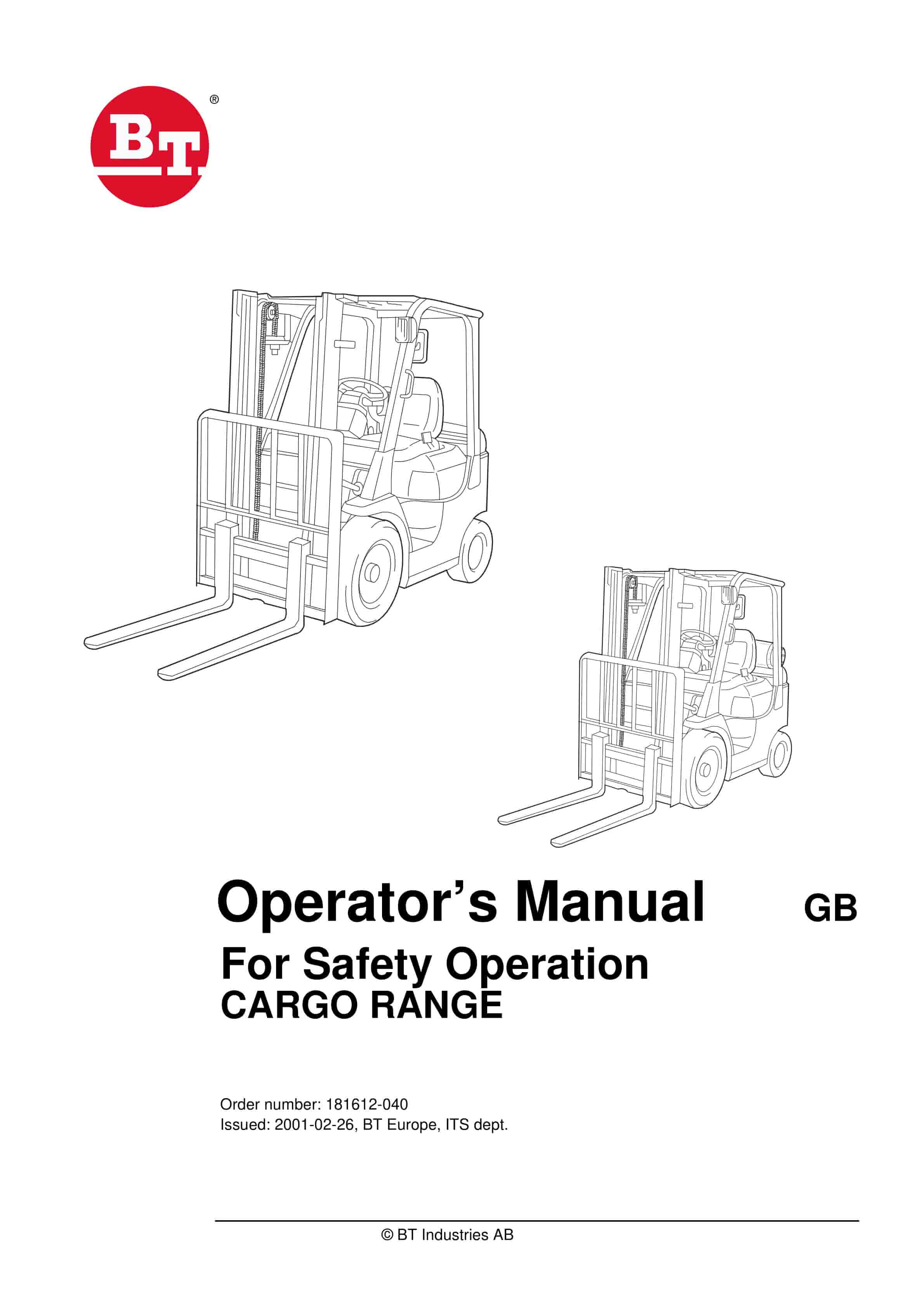
BT Safety Operation Cargo Range Operator Manual 181612-040
$30.00
- Type Of Manual: Operator Manual
- Manual ID: 181612-040
- : Operator Manual PDF
- Number of Pages: 66
- Size: 3.3MB
- Format: PDF
Product details
-
Model List:
- Safety Operation Cargo Range
- 1. For Safety Operation CARGO RANGE
- 1.1. Order number 181612-040
- 1.1.1. Issued 2001-02-26, BT Europe, ITS dept.
- 1.1.2. FOREWORD
- 1.1.3. CORRECT OPERATING PROCEDURE
- 1.1.3.1. Load and vehicle stability
- 1.1.3.2. Load capacity chart
- 1.1.3.3. Load capacity
- 1.1.3.4. Load center
- 1.1.3.5. Maximum fork height
- 1.1.3.6. How to read the load capacity chart
- 1.1.3.7. How to read the name plate
- 1.1.3.7.1. Vehicle type
- 1.1.3.7.2. Special vehicle type, Attachment type
- 1.1.3.7.3. Frame No.
- 1.1.3.7.4. Vehicle weight
- 1.1.3.7.5. Mast lifting heigt
- 1.1.3.7.6. Front tread
- 1.1.3.7.7. Tire seize
- 1.1.3.7.8. Air pressur
- 1.1.3.7.9. The year of manufacture
- 1.1.3.7.10. UL specification
- 1.1.3.7.11. Load capacity
- 1.1.3.7.12. Load centre
- 1.1.3.8. Handling a new forklift truck
- 1.1.3.8.1. Do nor race the engine unnecessarily.
- 1.1.3.8.2. After starting the engine, allow it to warm up fully before starting work
- 1.1.3.8.3. Avoid rough handling and driving. Do not overwork the forklift truck.
- 1.1.3.8.4. Be sure that the new vehicle recives inspection service and periodic maintenance as noted in t…
- 1.1.3.9. Engine starting and post-starting procedures
- 1.1.3.9.1. Set the shift lever to neutral.
- 1.1.3.9.2. Put on the parking brake.
- 1.1.3.9.3. Set the engine switch to GLOW and wait for the glow plug controller to indicate the red hot co…
- 1.1.3.9.4. Turn the engine switch to ON, see that the oil warning lamp is lit, then pump the accelerator …
- 1.1.3.10. Vehicle operation
- 1.1.3.11. Takeoff
- 1.1.3.12. IMPORTANT
- 1.1.3.13. Gearshifting
- 1.1.3.13.1. Bring the vehicle to a full stop before reversing gears.
- 1.1.3.13.2. In the unloaded condition, 2nd gear may be used for takeoff and travel, but in the the loaded …
- 1.1.3.14. Steering
- 1.1.3.14.1. The left hand is used to turn the steering wheel by the knob. The right hand works the loading…
- 1.1.3.14.2. This forklift truck is steered by the rear wheels. The steering wheel turns easily, so watch o…
- 1.1.3.15. Picking up loads
- 1.1.3.16. Unloading
- 1.1.3.16.1. If the mast is tilted backward at first when loading, the fork tips will strike the object for…
- 1.1.3.16.2. Do not approach the load fast and strike it.
- 1.1.3.16.3. When traveling with a load on forks, keep the mast tilted backward and the forks 15 to 20 cm o…
- 1.1.3.16.4. Never travel with the mast tilted forward and the load raised. The load centre of balance can …
- 1.1.3.16.5. Back down a slope slowly when carrying a load.
- 1.1.3.17. Stopping and parking
- 1.1.3.17.1. To come to a stop, release your foot from the accelarator pedal, reduce speed and brake the we…
- 1.1.3.17.2. Do not attempt to stop on a slope or incline by working the accelarator pedal with the unit in…
- 1.1.3.17.3. When parking the vehicle, stop at a place where it will not be in the way of other vehicles. S…
- 1.1.3.18. Road or surface condition
- 1.1.3.19. Snowy or frozen surfaces
- 1.1.3.20. Handling in hot weather
- 1.1.3.20.1. Clogged radiator fins can cause overheating. Clean them out regularly with a blast of compress…
- 1.1.3.20.2. Check the fan belt tension and adjust to the specified tension.
- 1.1.3.20.3. Even if the engine overheats and the coolant boils over, let the engine idle a while until the…
- 1.1.3.21. Cool weather vehicle handling
- 1.1.3.21.1. When Fueling up. Always fill the tank up to the top. This minimizes the air within the tank an…
- 1.1.3.21.2. Battery percautions. The higher the specific gravity and the greater the charge level, the les…
- 1.1.3.22. Use of anti-freeze
- 1.1.3.23. Mixing ratio for anti-freeze
- 1.1.4. SAFETY INFORMATION
- 1.1.4.1. Conditions for Normal Vehicle Use
- 1.1.4.1.1. Work Environment
- 1.1.4.1.2. For engine-powered forklift trucks
- 1.1.4.1.3. For electric-powered forklift trucks
- 1.1.4.1.4. Work environment hazards
- 1.1.4.1.5. Conditions that apply when attachments are used
- 1.1.4.1.6. Information on Opearating the Forklift Truck
- 1.1.4.1.7. Fundamental Safeyt Guidlines
- 1.1.4.1.8. Pedestrians
- 1.1.4.1.9. Hazards arising when attachments are used on the forklift truck
- 1.1.4.1.10. Handling of fuel
- 1.1.4.1.11. Refuelling
- 1.1.4.1.12. Shipping, Loading and Unloading the Forklift truck
- 1.1.4.1.13. Observe the following cautions when lifting the forklift truck
- 1.1.4.1.14. Assembling the forklift truck and mounting attachments
- 1.1.4.1.15. Towing the forklift truck and moving incomplete forklift trucks
- 1.1.4.1.16. Leaving the forklift truck idle and long-term storage
- 1.1.4.1.17. Care of Engine Room
- 1.1.4.1.18. Maintenance of Brake System
- 1.1.4.1.19. Maintenance of Hydraulic System
- 1.1.4.1.20. Battery Care
- 1.1.4.1.21. Drive System Maintenance
- 1.1.4.1.22. Inspection of Forklift Trucks while in Storage
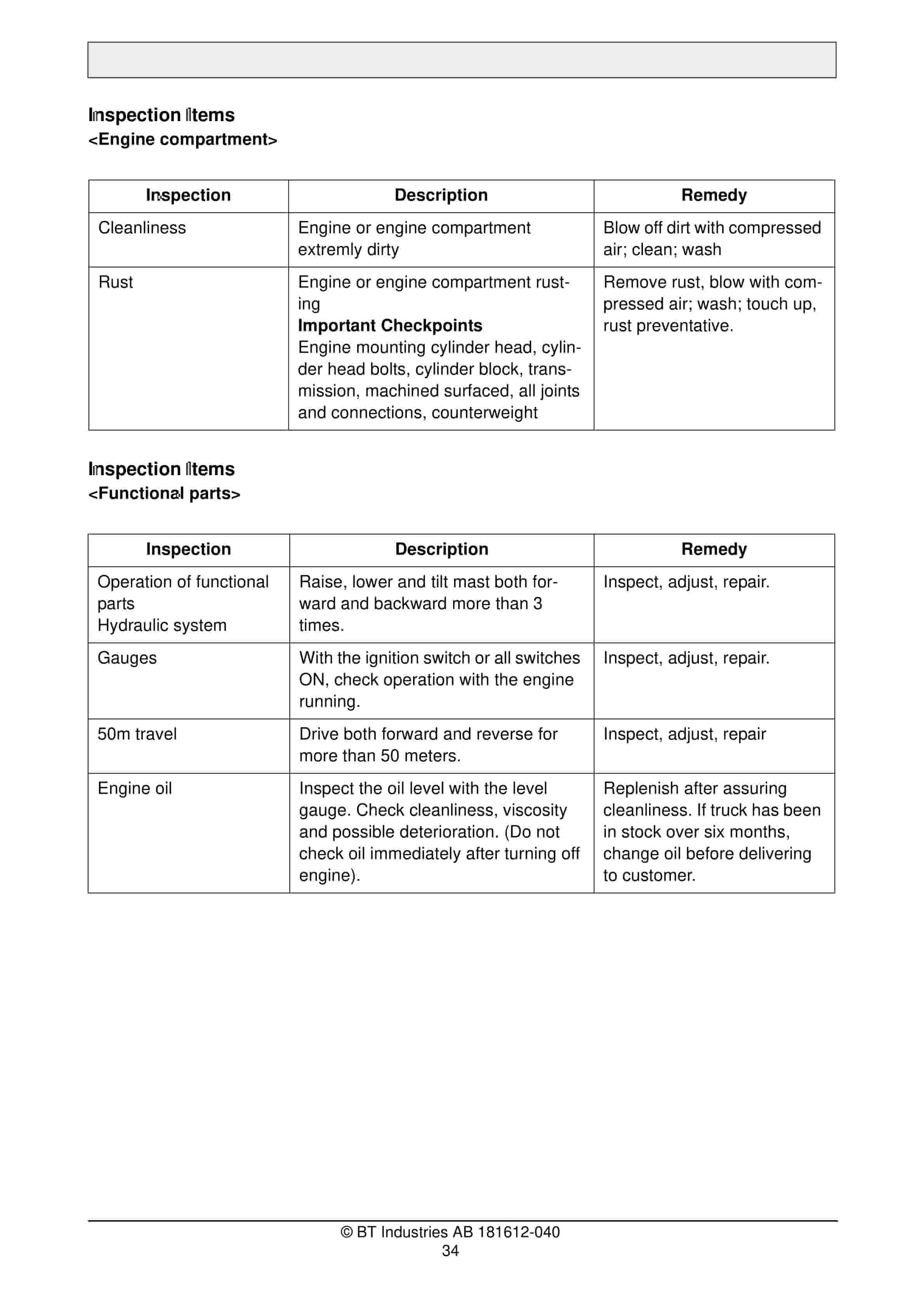
- 1.1.4.1.23. Inspection Items
- 1.1.4.1.24. Inspection Items
- 1.1.4.1.25. Inspection Items
- 1.1.4.1.26. Inspection Items
- 1.1.4.1.27. Inspection Items
- 1.1.4.1.28. Inspectional Items
- 1.1.4.1.29. Battery Maintenance
- 1.1.4.1.30. Service Requirements
- 1.1.4.1.31. Notes on daily equipment checks
- 1.1.4.1.32. Forklift truck inspections (function tests)
- 1.1.4.1.33. The Forklift truck, Forklift Equipment and Attachments
- 1.1.4.1.34. Safety Equipment and Warning Labels
- 1.1.4.1.35. Other Notes
- 1.1.4.1.36. Handling the Battery Safely
- 1.1.4.1.37. Notes on charging
- 1.1.4.1.38. Notes on Other Hazards
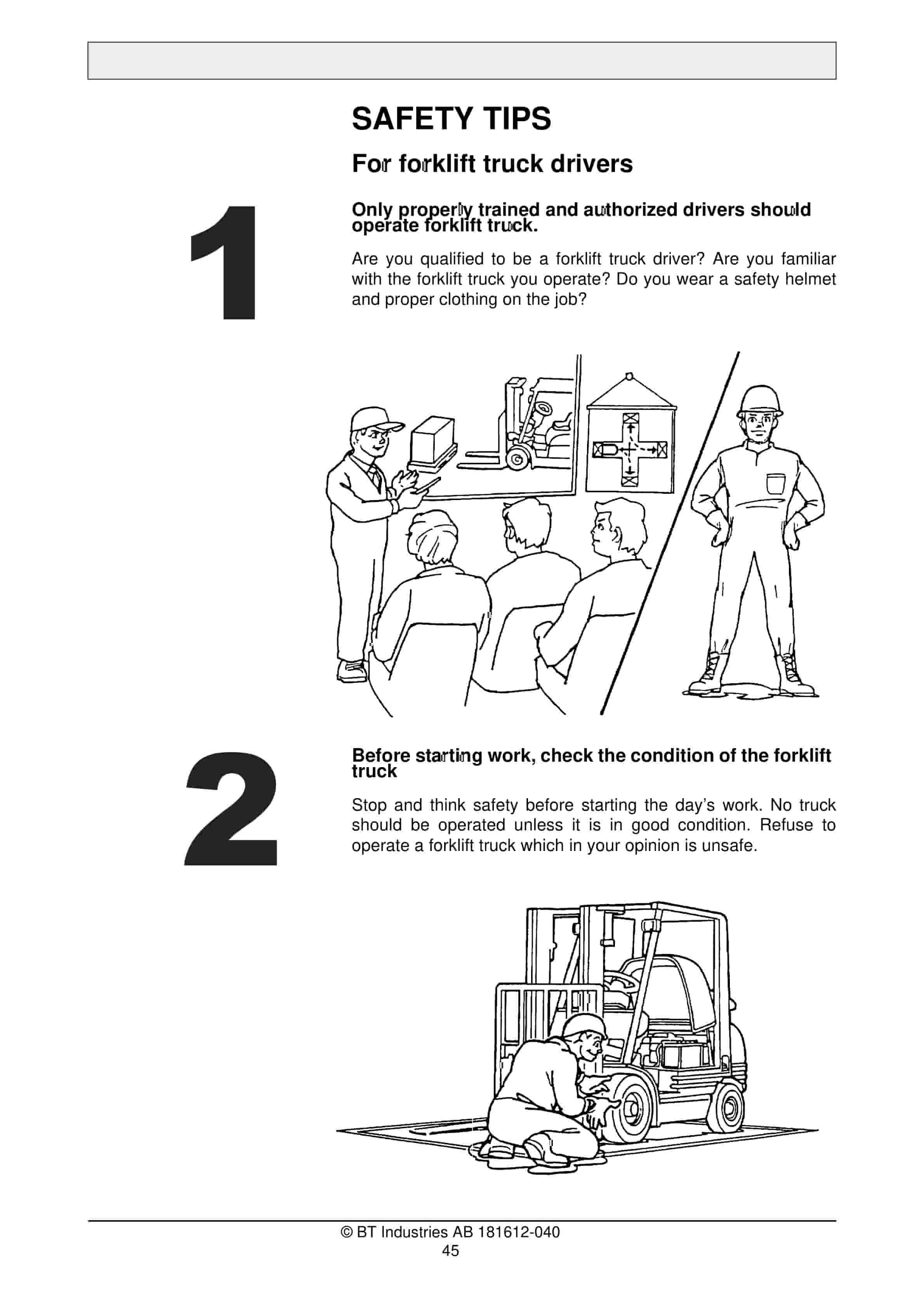
- 1.1.5. SAFETY TIPS
- 1.1.5.1. For forklift truck drivers
- 1.1.5.1.1. Only properly trained and authorized drivers should operate forklift truck.
- 1.1.5.1.2. Before starting work, check the condition of the forklift truck
- 1.1.5.1.3. Immediately report to your supervisor any obvious defects or required repairs
- 1.1.5.1.4. Dont overload
- 1.1.5.1.5. Always use proper size pallet
- 1.1.5.1.6. Set the forks to the maximum possible width
- 1.1.5.1.7. Watch for loose loads
- 1.1.5.1.8. Position loads evenly on the forks for proper balance
- 1.1.5.1.9. Never elevate a load with the forklift truck on a incline
- 1.1.5.1.10. Do not permit anyone to stand between elevated forks
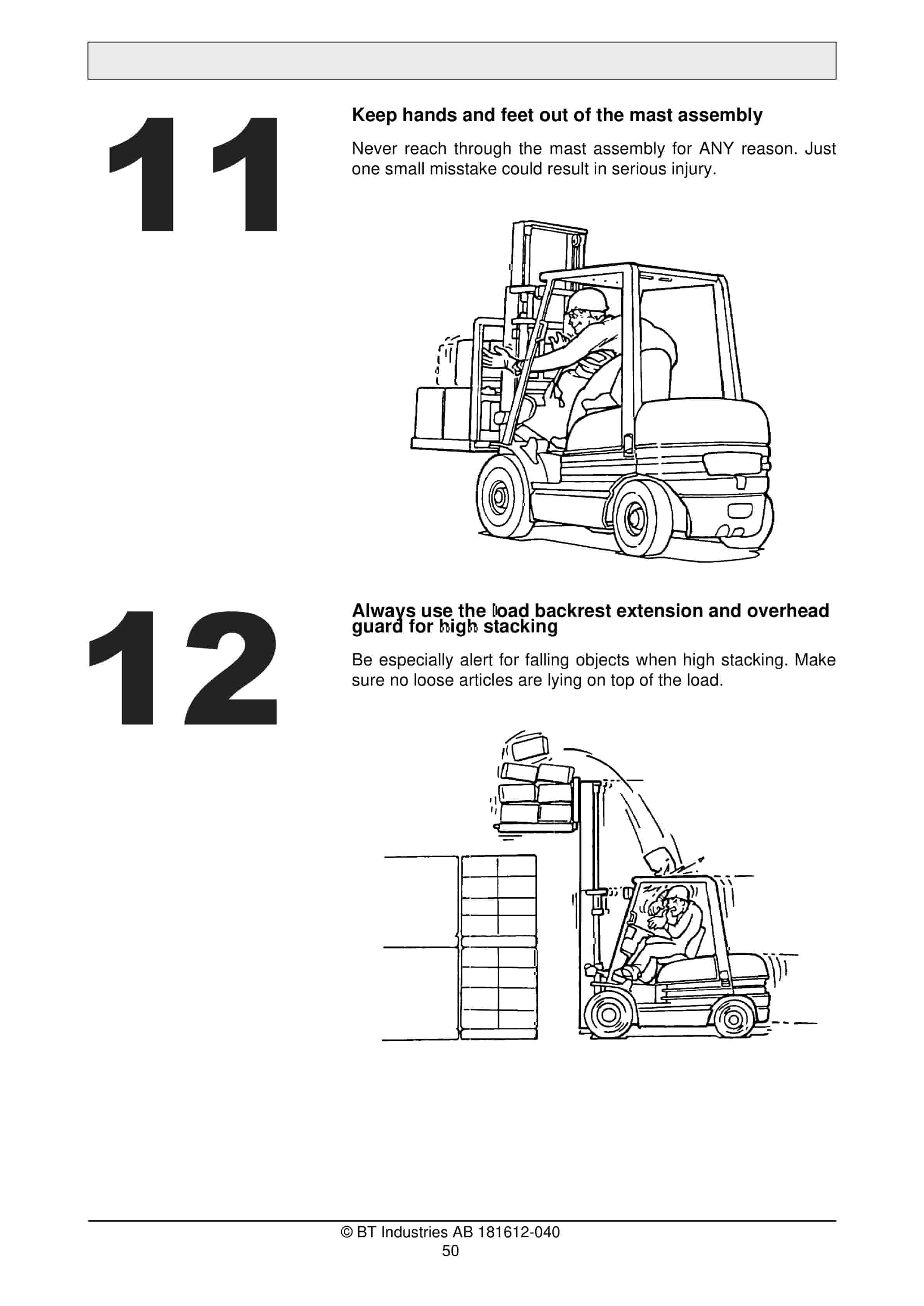
- 1.1.5.1.11. Keep hands and feet out of the mast assembly
- 1.1.5.1.12. Always use the load backrest extension and overhead guard for high stacking
- 1.1.5.1.13. Do not elevate the load with the mast tilted forward
- 1.1.5.1.14. Carry loads as close to the floor as possible
- 1.1.5.1.15. Keep the load against the backrest, with the mast tilted backward
- 1.1.5.1.16. Always look before starting
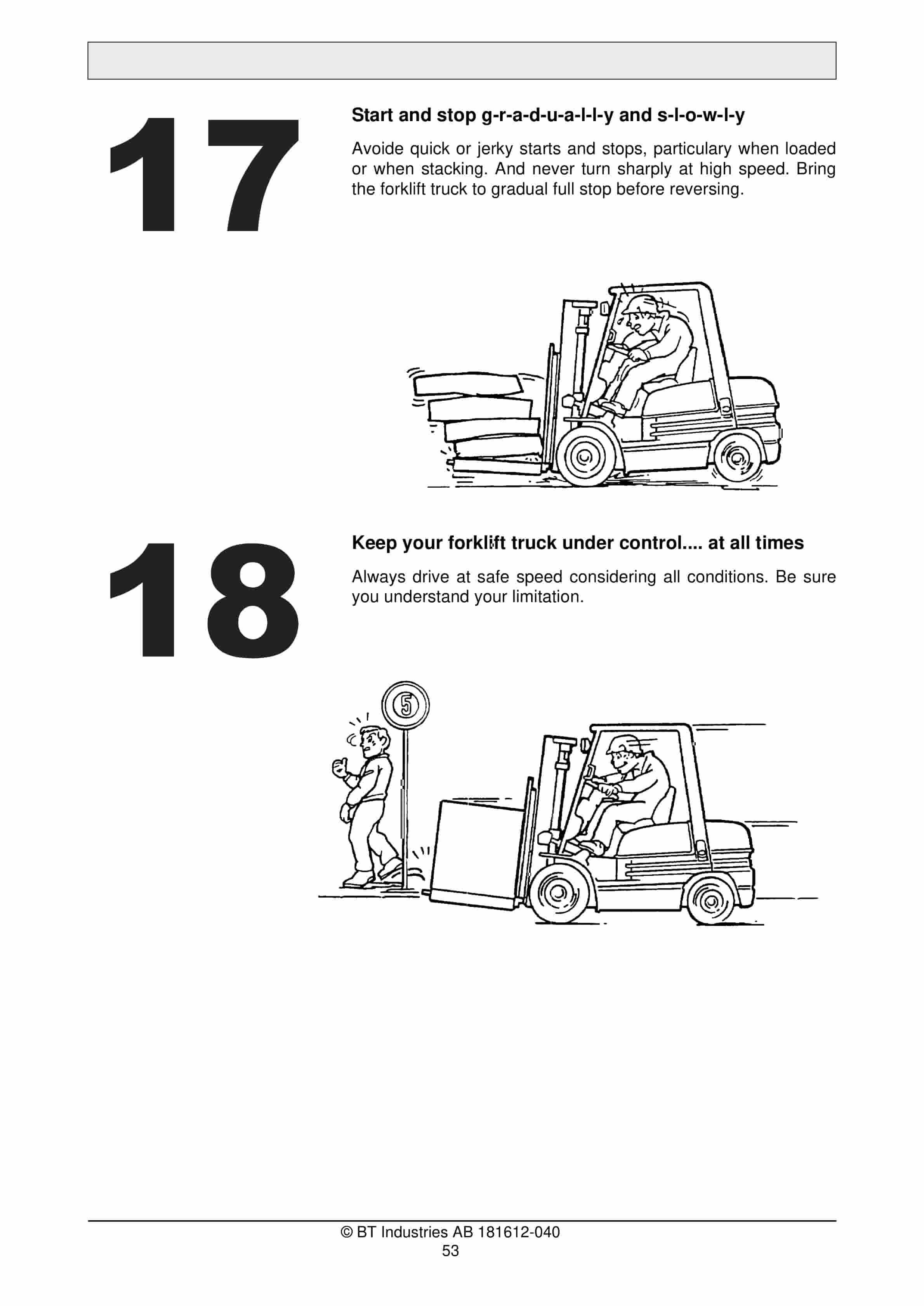
- 1.1.5.1.17. Start and stop g-r-a-d-u-a-l-l-y and s-l-o-w-l-y
- 1.1.5.1.18. Keep your forklift truck under control…. at all times
- 1.1.5.1.19. Always keep a safe distance from other vehicles
- 1.1.5.1.20. Never overtake other vehicles
- 1.1.5.1.21. Avoid stunt driving and horseplay
- 1.1.5.1.22. Dont daydream Stay alert
- 1.1.5.1.23. Slow down for wet, slippery areas
- 1.1.5.1.24. Go slow and sound the horn at corners
- 1.1.5.1.25. Cross railroad tracks slowly and diagonally whenever possible
- 1.1.5.1.26. Avoid running over loose objects
- 1.1.5.1.27. Always watch load and mast overhead clearance
- 1.1.5.1.28. Watch side clearance
- 1.1.5.1.29. Keep hands and feet inside the truck
- 1.1.5.1.30. Watch rear and swing
- 1.1.5.1.31. Do not allow the fork tips to strike objects
- 1.1.5.1.32. For better vision with bulky loads, drive backward
- 1.1.5.1.33. Observe floor loading limits
- 1.1.5.1.34. Have brakes set and wheel blocks in place while loading and unloading
- 1.1.5.1.35. Always drive with the load upphill on a ramp
- 1.1.5.1.36. Use an assistant when going up or down a ramp with a bulky load
- 1.1.5.1.37. Dont use your forklift truck as a personnel lift
- 1.1.5.1.38. Dont carry passengers
- 1.1.5.1.39. Shut off your forklift truck when leaving it unattended
- 1.1.5.1.40. No smoking while refueling
- 1.1.5.1.41. Check the condition of your forklift truck after the days work
- 1.1.5.1.42. Know your forklift truck and think safety
Related products
-
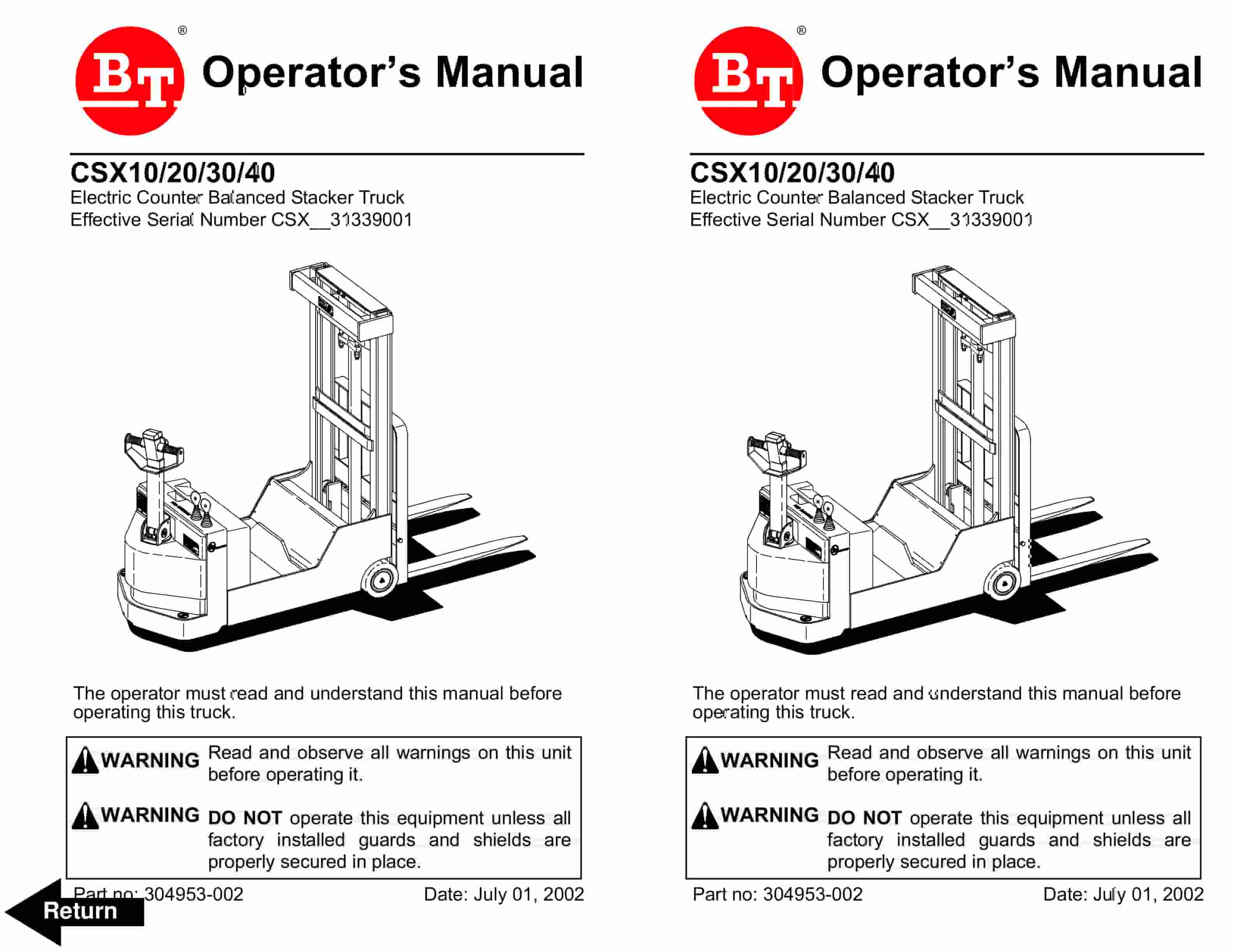
BT CSX Electric Counter Balanced Stacker Truck Operator Manual 304953-002
$30.00 Add to cart -
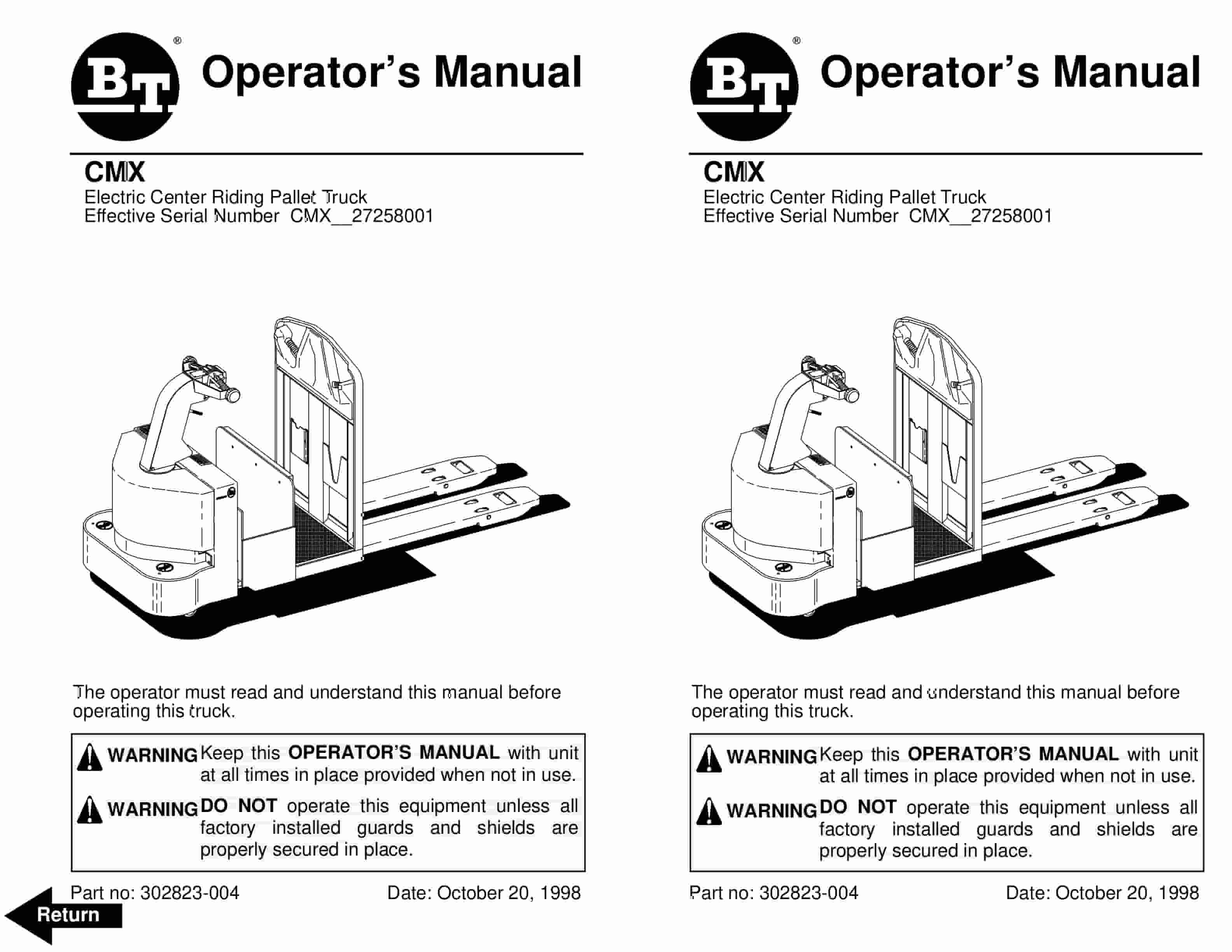
BT CMX Electric Center Riding Pallet Truck Operator Manual 302823-004
$30.00 Add to cart -
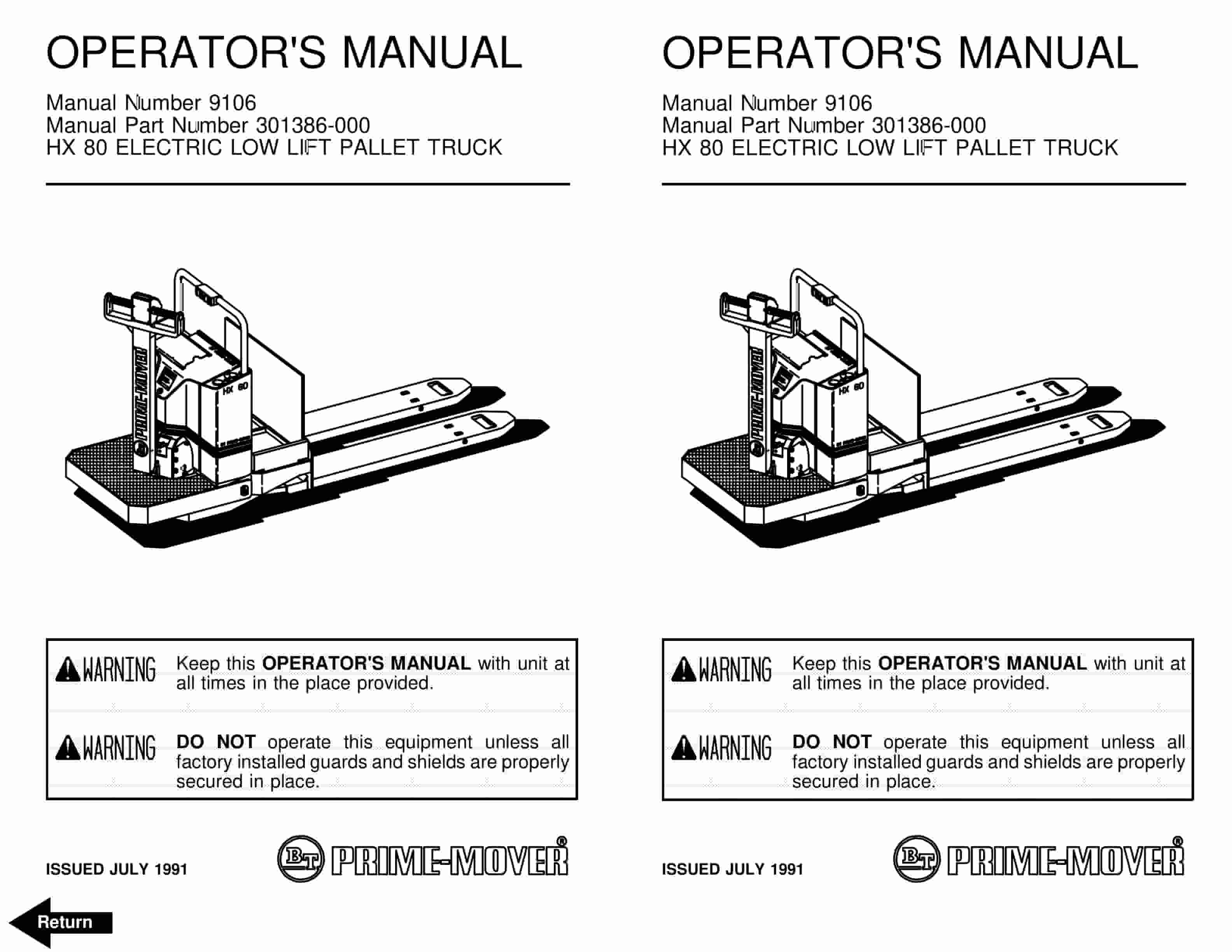
BT HX-80 Electric Low Lift Pallet Truck Operator Manual 301386-000
$30.00 Add to cart -
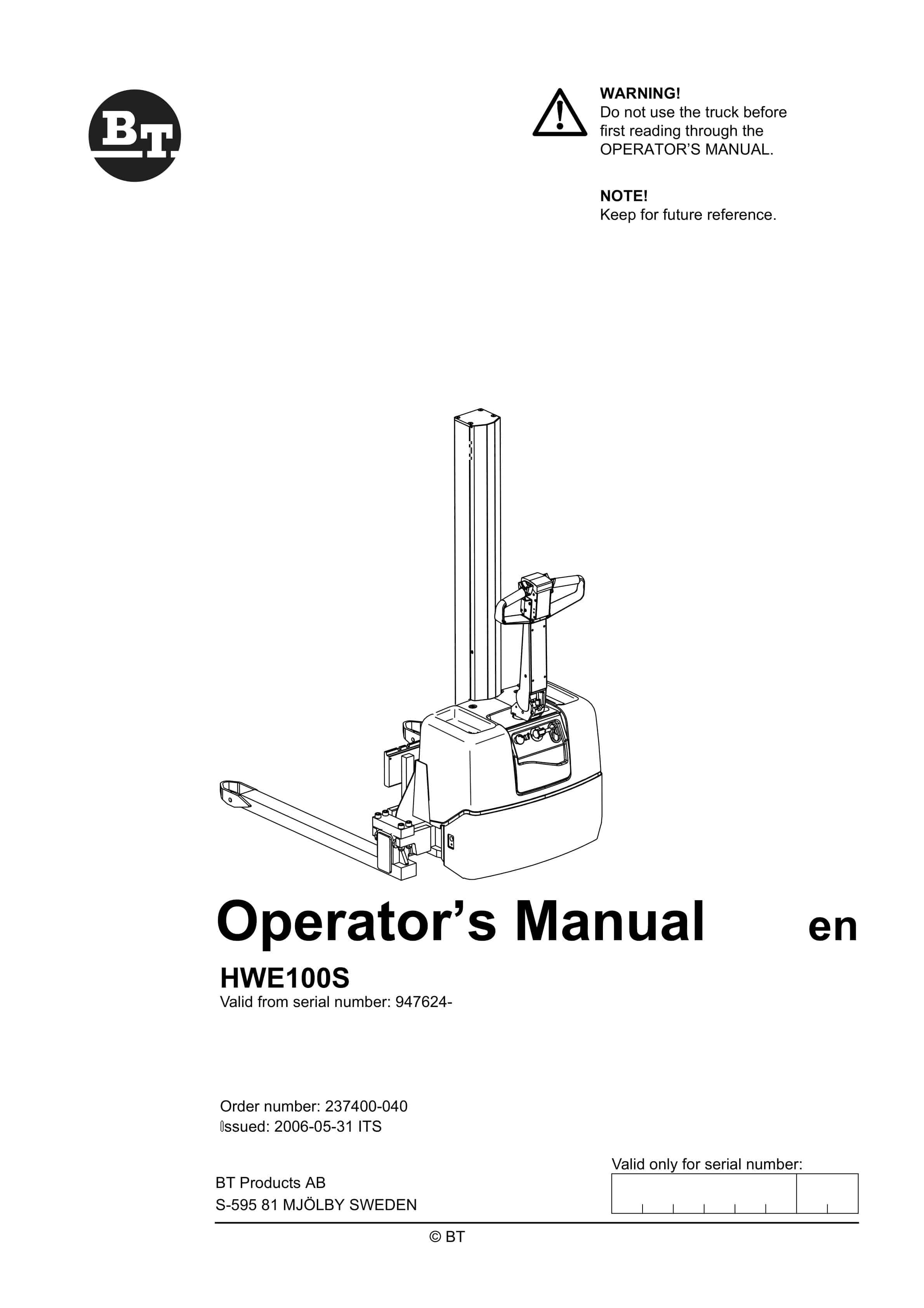
BT HWE100S Operator Manual 237400-040
$30.00 Add to cart -
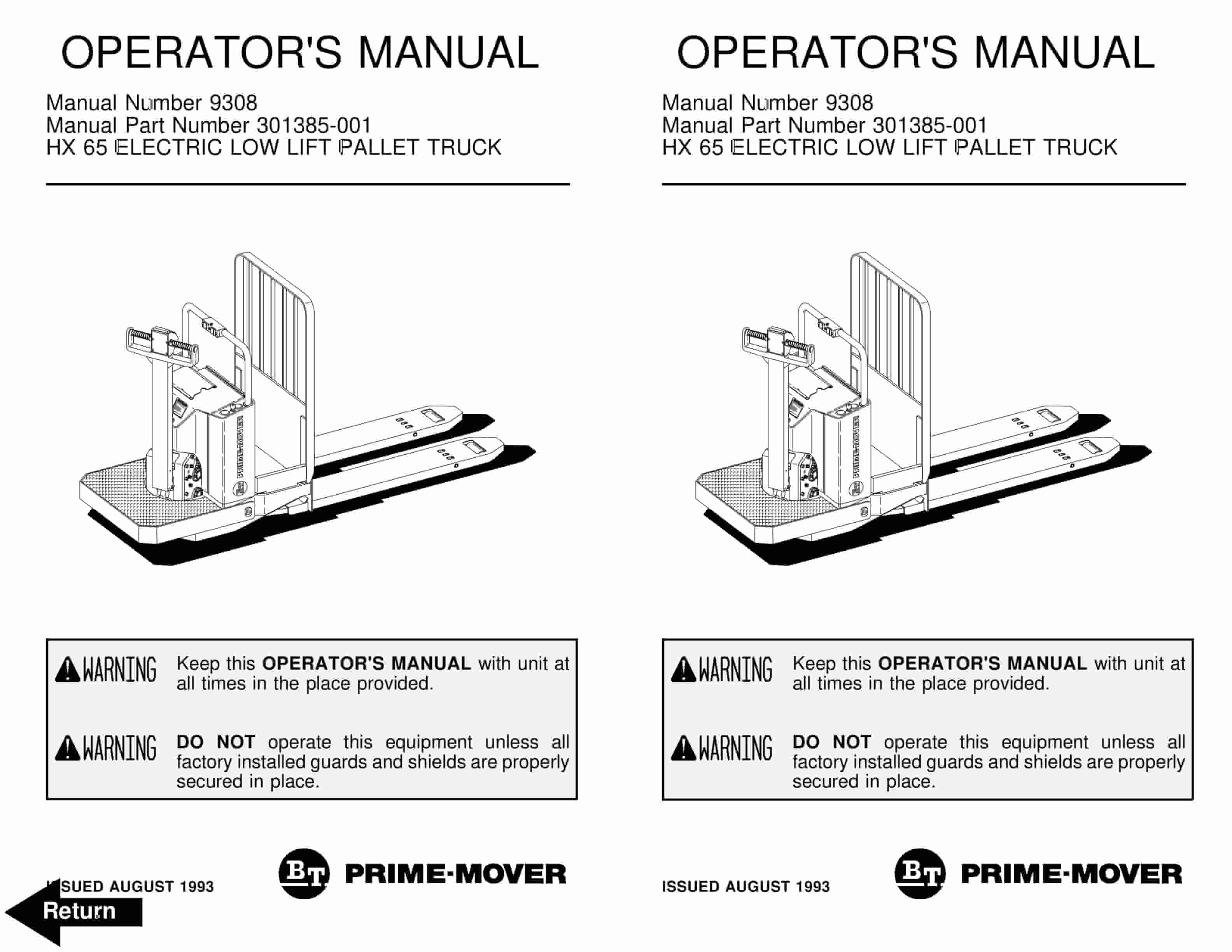
BT HX-65 Electric Low Lift Pallet Truck Operator Manual 301385-001
$30.00 Add to cart


