

Bucyrus RH120E Hydraulic Excavator Operating Instructions 3725047
$30.00
- Type Of Manual: Operating Instructions
- Manual ID: 3725047
- Number of Pages: 304
- Size: 6.7MB
- Format: PDF
Product details
-
Model List:
- RH120E Hydraulic Excavator
- 1. Title page
- 2. INTRODUCTION
- 2.1. PREFACE
- 2.1.1. About this Operating Instructions
- 2.1.2. Further machine documentation
- 2.2. WARRANTY
- 2.3. FUNDAMENTAL SAFETY INSTRUCTIONS
- 2.3.1. Warnings and symbols
- 2.3.2. Contents of the Declaration of Conformity
- 2.4. DESIGNATED USE
- 2.4.1. Noise emissions
- 2.4.2. Vibration data
- 2.5. ORGANIZATIONAL MEASURES
- 2.5.1. Selection and qualification of personnel basic responsibilities
- 2.5.2. Safety instructions governing specific operational phases
- 2.5.3. Special work in conjunction with utilization of the machine and maintenance and repairs as well as troubleshooting during work disposal of parts and consumables
- 2.5.4. Warning of special dangers
- 2.5.5. Gas, dust, steam and smoke
- 2.5.6. Hydraulic equipment
- 2.6. FIRE AND EXPLOSION HAZARD
- 3. OPERATION
- 3.1. OPERATION – SAFETY INSTRUCTIONS
- 3.1.1. Operating Instructions, where to store it in the drivers cab
- 3.2. FIRE AND EXPLOSION HAZARD
- 3.3. DESCRIPTION OF THE EXCAVATOR
- 3.3.1. Excavator layout
- 3.3.2. Undercarriage
- 3.3.3. Superstructure
- 3.3.4. Hydraulic system
- 3.3.5. Control and Monitoring Platform (CAMP)
- 3.3.6. Board-Control-System (BCS)
- 3.3.7. Demand control / Zero-flow regulation
- 3.3.8. Automatic reset to idling
- 3.3.9. Electrical system
- 3.3.10. Entering and leaving the machine Safety instructions
- 3.3.11. Access ladder lighting
- 3.3.12. Swinging ladder
- 3.3.13. Folding ladder (optional)
- 3.3.14. Escape ladder (optional)
- 3.3.15. Switching the cab interior lighting on and off
- 3.3.16. Switching the maintenance lights on and off
- 3.3.17. Emergency shut-off function
- 3.3.18. Shutting off the supply voltage (battery main switch)
- 3.3.19. Drivers seat
- 3.3.20. Reducing the operators exposure to vibrations
- 3.3.21. Trainers / instructors seat
- 3.3.22. Fire extinguisher
- 3.3.23. Fire extinguisher (option)
- 3.3.24. Automatic fire-extinguishing system (optional)
- 3.3.25. Windscreen washer
- 3.3.26. Harness (optional)
- 3.4. MONITORING, WARNING AND CONTROL ELEMENTS
- 3.4.1. Engine 1 (LH), control and monitoring
- 3.4.2. Engine 2 (RH), control and monitoring
- 3.5. PUTTING THE MACHINE INTO OPERATION
- 3.5.1. Reducing the operators exposure to noise
- 3.5.2. Refuelling
- 3.5.3. Back-up heating (option), filling in fuel
- 3.5.4. Service station (tanklift)
- 3.5.5. Switching the electrical system on and off
- 3.5.6. Engines, emergency shut-off
- 3.5.7. Preheating system for engine and hydraulic oil (optional)
- 3.5.8. Fuel preheating system (optional)
- 3.6. STARTING AND STOPPING THE ENGINES
- 3.6.1. Starting the engines
- 3.6.2. Starting the left-hand engine
- 3.6.3. Starting the right-hand engine
- 3.6.4. Engines adjusting the speed
- 3.6.5. Starting the engines at low temperatures
- 3.6.6. Shutting off the engines
- 3.6.7. Shutting off the left-hand engine
- 3.6.8. Shutting off the right-hand engine
- 3.7. AIR CONDITIONER (OPTION)
- 3.7.1. Back-up heating drivers cab (option)
- 3.7.2. Back-up heating (option)
- 3.8. TRAVELLING, SAFETY INSTRUCTIONS
- 3.9. TRAVELLING
- 3.9.1. Superstructure basic position
- 3.9.2. Travelling forwards/backwards
- 3.9.3. Superstructure holding brake
- 3.9.4. Track parking brake
- 3.10. TRANSPORTING THE MACHINE
- 3.10.1. Transport – Safety instructions
- 3.11. WORKING OPERATION – SAFETY INSTRUCTIONS
- 3.12. WORKING OPERATION
- 3.12.1. Before starting work
- 3.12.2. Activating the electronic excavator control
- 3.12.3. Swinging the superstructure
- 3.12.4. Braking the superstructure
- 3.12.5. Working
- 3.12.6. After daily operation
- 3.13. OPTIONAL EQUIPMENT
- 3.13.1. Water spraying system
- 3.13.2. Additional silencers
- 3.14. ASSEMBLING WORKING EQUIPMENT – SAFETY INSTRUCTIONS
- 3.14.1. Securing the machine
- 3.15. CORROSION PROTECTION FOR PINS AND BEARINGS (BUSHINGS AND HUBS)
- 4. INSPECTION AND SERVICING
- 4.1. INSPECTION AND SERVICING – SAFETY INSTRUCTIONS
- 4.2. INSPECTION AND SERVICING WORK, FIRE AND EXPLOSION HAZARD
- 4.3. INSPECTION AND SERVICING PLANS – INSTRUCTIONS
- 4.3.1. Intervals
- 4.3.2. Change of engine oil l
- 4.3.3. Air-intake system
- 4.3.4. Oils / Greases
- 4.3.5. Cleaning jobs
- 4.3.6. Components
- 4.3.7. Plan V
- 4.3.8. Plan N
- 4.3.9. Plan T and W
- 4.3.10. Plan A E
- 4.4. LUBRICATING CHART GREASE
- 4.4.1. Lubricating chart Grease (legend)
- 4.4.2. Filling quantities Grease
- 4.5. INSPECTION PLAN – OIL
- 4.5.1. Inspection plan Oil (legend)
- 4.5.2. Filling quantities – oil
- 4.5.3. Filling quantities – other
- 4.6. LUBRICANTS
- 4.6.1. Notes on the selection of oils and greases
- 4.6.2. Avoid mixing of different hydraulic fluids
- 4.6.3. Oils for combustion engines
- 4.6.4. II. Oils for hydraulic system
- 4.6.5. III.a Oils for pump gearboxes
- 4.6.6. III.b Oils for swing gearboxes
- 4.6.7. III.c Oils for travel gearboxes
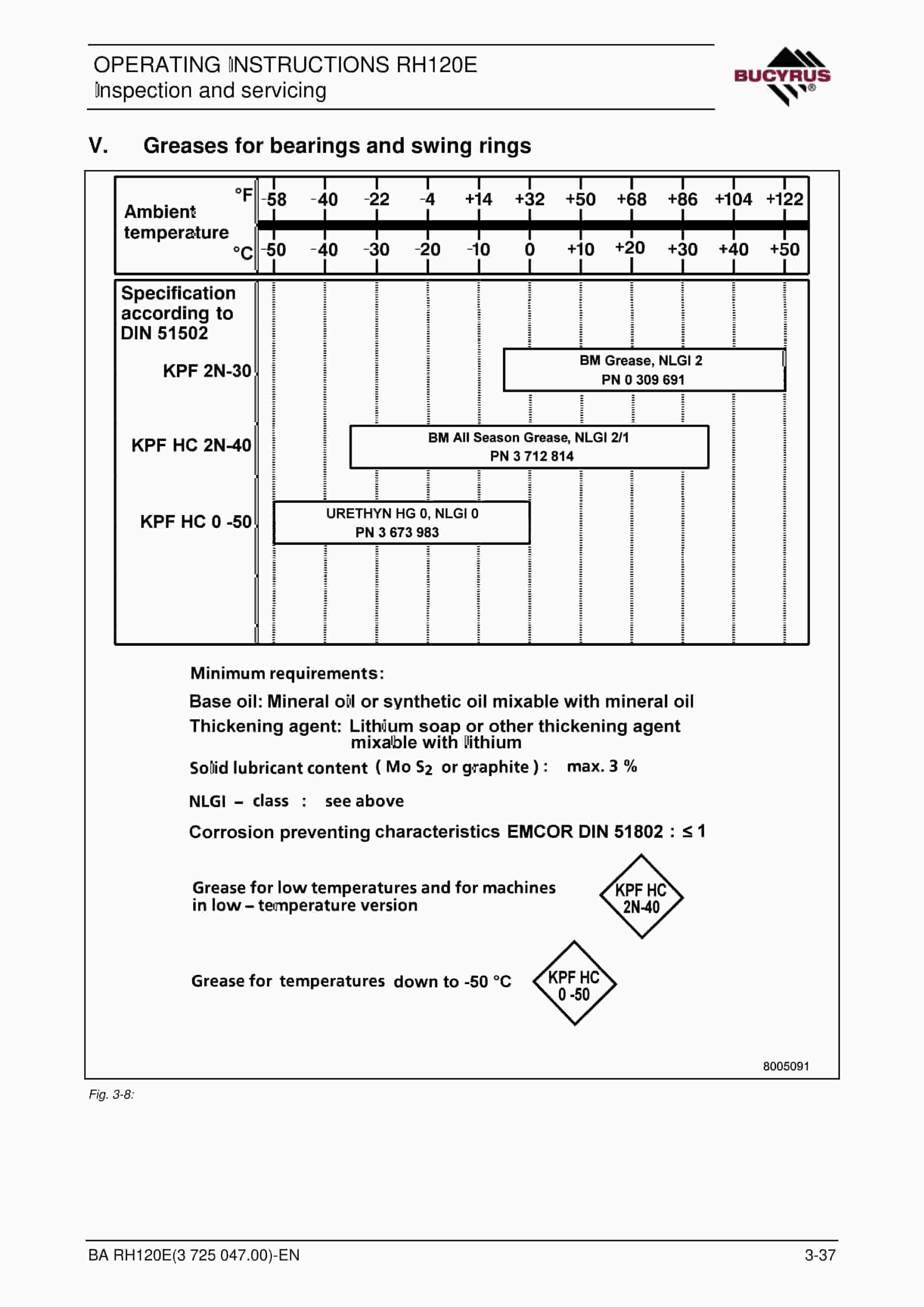
- 4.6.8. Greases for bearings and swing rings
- 4.7. SERVICING WORK
- 4.7.1. Hose line for oil and cooling liquid changes
- 4.8. ENGINE
- 4.8.1. Engine – Safety instructions
- 4.8.2. Checking the engine oil level / Topping up
- 4.8.3. Changing the engine oil
- 4.8.4. Replacing the oil filters
- 4.8.5. Engine oil reservoir, filling in engine oil
- 4.8.6. Cold-starting fluid (ether) – Replacing the pressure vessel
- 4.9. COOLING SYSTEM
- 4.9.1. Radiators
- 4.9.2. Cooling liquid change
- 4.10. AIR-INTAKE SYSTEM
- 4.10.1. Dust trap, cleaning
- 4.10.2. Main filter elements
- 4.10.3. Safety filter element
- 4.10.4. Air-intake lines
- 4.11. FUEL SYSTEM
- 4.11.1. Fuel system – Safety instructions
- 4.11.2. Replacing the fuel filter
- 4.11.3. Primary fuel filter, drain water
- 4.11.4. Replacing the primary fuel filter
- 4.11.5. Venting the fuel system
- 4.11.6. Cleaning the fuel tanks
- 4.11.7. Water trap (option)
- 4.12. ELECTRICAL SYSTEM
- 4.12.1. Electrical system – Safety instructions
- 4.12.2. Alternator – Instructions
- 4.12.3. Battery
- 4.12.4. Switchgear cabinet
- 4.12.5. Equipotential bonding
- 4.12.6. Floodlight projector, replacing the lamp
- 4.13. HYDRAULIC SYSTEM
- 4.13.1. Hydraulic system – Safety instructions
- 4.13.2. Depressurizing the hydraulic system
- 4.13.3. Checking the hydraulic oil level
- 4.13.4. Hydraulic oil return-flow filters (hydraulic oil reservoir), replace
- 4.13.5. Bypass valves (hydraulic oil reservoir), replace
- 4.13.6. Replacing the hydraulic oil return-flow filters (filter housing)
- 4.13.7. Bypass valves (filter housing – cooling system), replace
- 4.13.8. Breather filter, replace
- 4.13.9. Filter (servo circuit), replace
- 4.13.10. High-pressure filter for working hydraulics, replace
- 4.13.11. High-pressure filters for swing circuit, replace
- 4.13.12. Filter pump control, clean
- 4.13.13. Changing the hydraulic oil
- 4.13.14. Avoid mixing of different hydraulic fluids
- 4.13.15. Venting the hydraulic system
- 4.13.16. Cleaning the hydraulic oil cooler
- 4.13.17. Electronic excavator control
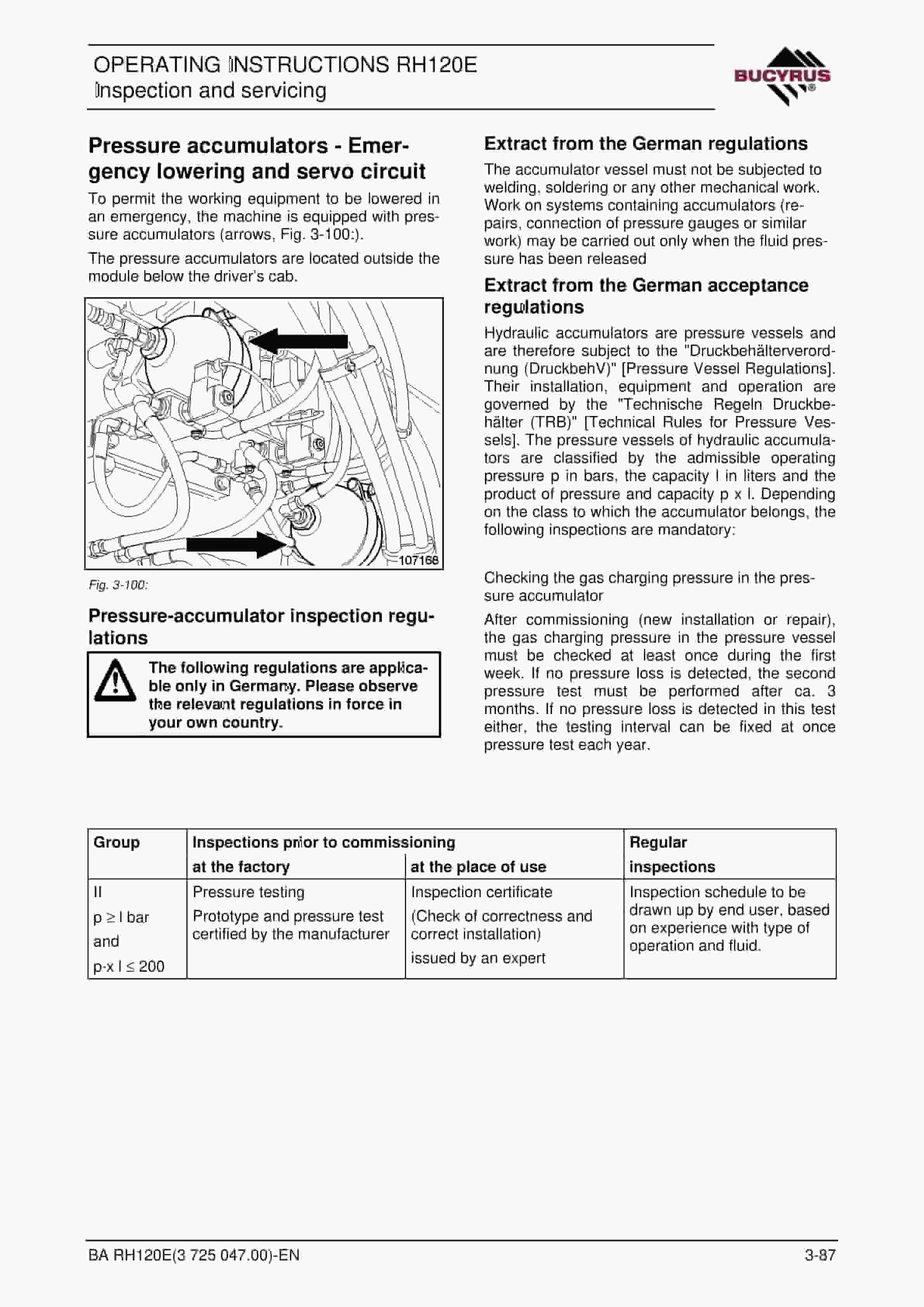
- 4.13.18. Pressure accumulators – Emergency lowering and servo circuit
- 4.14. PUMP TRANSFER GEARBOX
- 4.14.1. Checking the gearbox oil level / Topping up with oil
- 4.14.2. Gearbox venting
- 4.14.3. Pump transfer gearbox lube oil filters
- 4.15. SWING GEARBOX
- 4.15.1. Gearbox – Checking the oil level / Topping up with oil
- 4.15.2. Changing the gearbox oil
- 4.15.3. Gearbox venting
- 4.16. SWING GEARBOX
- 4.16.1. Gearbox – Checking the oil level / Topping up with oil
- 4.16.2. Changing the gearbox oil
- 4.16.3. Gearbox venting
- 4.17. TRAVEL GEARBOX
- 4.17.1. Gearbox – Checking the oil level / Topping up with oil
- 4.17.2. Travel gearbox – Changing oil
- 4.17.3. Pre-chamber – Changing the oil
- 4.17.4. Brake chamber – Changing oil
- 4.17.5. Breather filter
- 4.18. CRAWLER TRACKS
- 4.18.1. Track roller, Support roller
- 4.18.2. Track tensioner
- 4.18.3. Pressure-accumulator inspection regulations
- 4.18.4. Checking the gas charging pressure in the pressure accumulator
- 4.19. SWING RING
- 4.19.1. Swing ring – Instructions
- 4.19.2. Bearing races
- 4.20. CENTRAL LUBRICATING SYSTEM
- 4.20.1. Design
- 4.20.2. Function
- 4.20.3. Filling up the grease container
- 4.20.4. Breather filter grease container, check / replace
- 4.20.5. Checking the greasing pressure
- 4.20.6. Unblocking a grease line
- 4.20.7. Oilfilter replace (hydraulic circuit grease pump)
- 4.20.8. Grease filter replace (filling the grease container)
- 4.20.9. Grease filter replace (Grease lines)
- 4.21. OTHER MAINTENANCE
- 4.21.1. Engine
- 4.21.2. Heating and air conditioning
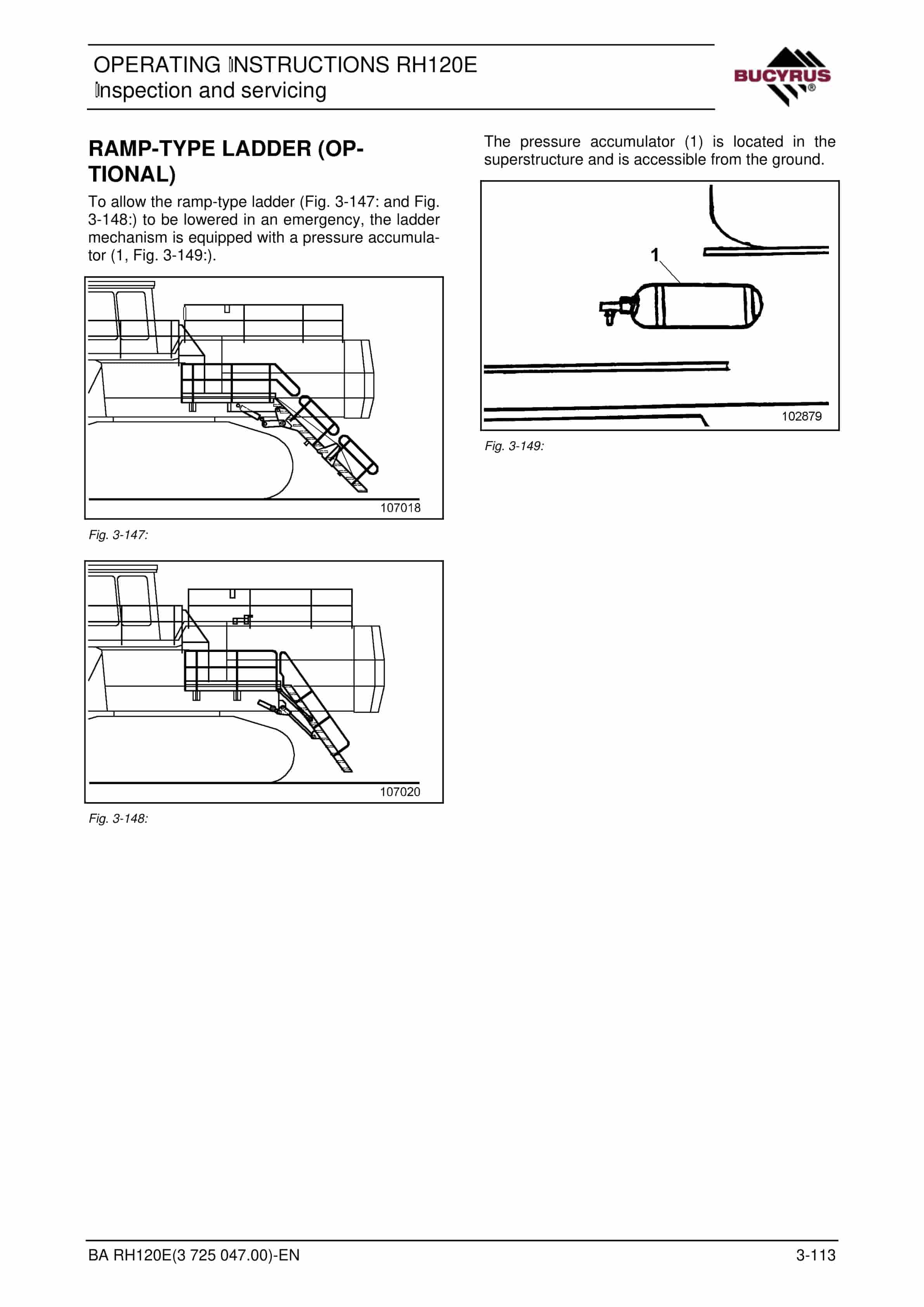
- 4.22. RAMP-TYPE LADDER (OPTIONAL)
- 4.22.1. Pressure-accumulator inspection regulations
- 4.22.2. Extract from the German regulations
- 4.22.3. Checking the gas charging pressure in the pressure accumulator
- 4.23. ON-BOARD CRANE (OPTIONAL)
- 4.23.1. Monitoring, warning and control elements
- 4.23.2. Checking the on-board crane
- 4.23.3. Drive unit
- 4.23.4. On-board crane
- 4.23.5. On-Board crane, checking tightness of fastening bolts
- 4.24. PUTTING THE EXCAVATOR OUT OF OPERATION AND RECOMMISSIONING
- 4.24.1. Putting the excavator out of operation
- 4.24.2. Battery storage
- 4.24.3. Recommissioning
- 4.25. NOTES
- 5. REPAIR WORK
- 5.1. REPAIR WORK – SAFETY INSTRUCTIONS
- 5.2. REPAIR WORK, FIRE AND EXPLOSION HAZARD
- 5.3. REPAIR WORK, ENGINE
- 5.4. ELECTRICAL SYSTEM
- 5.4.1. Assisted starting (with jumper cables) Safety instructions
- 5.4.2. Assisted starting (with jumper cables)
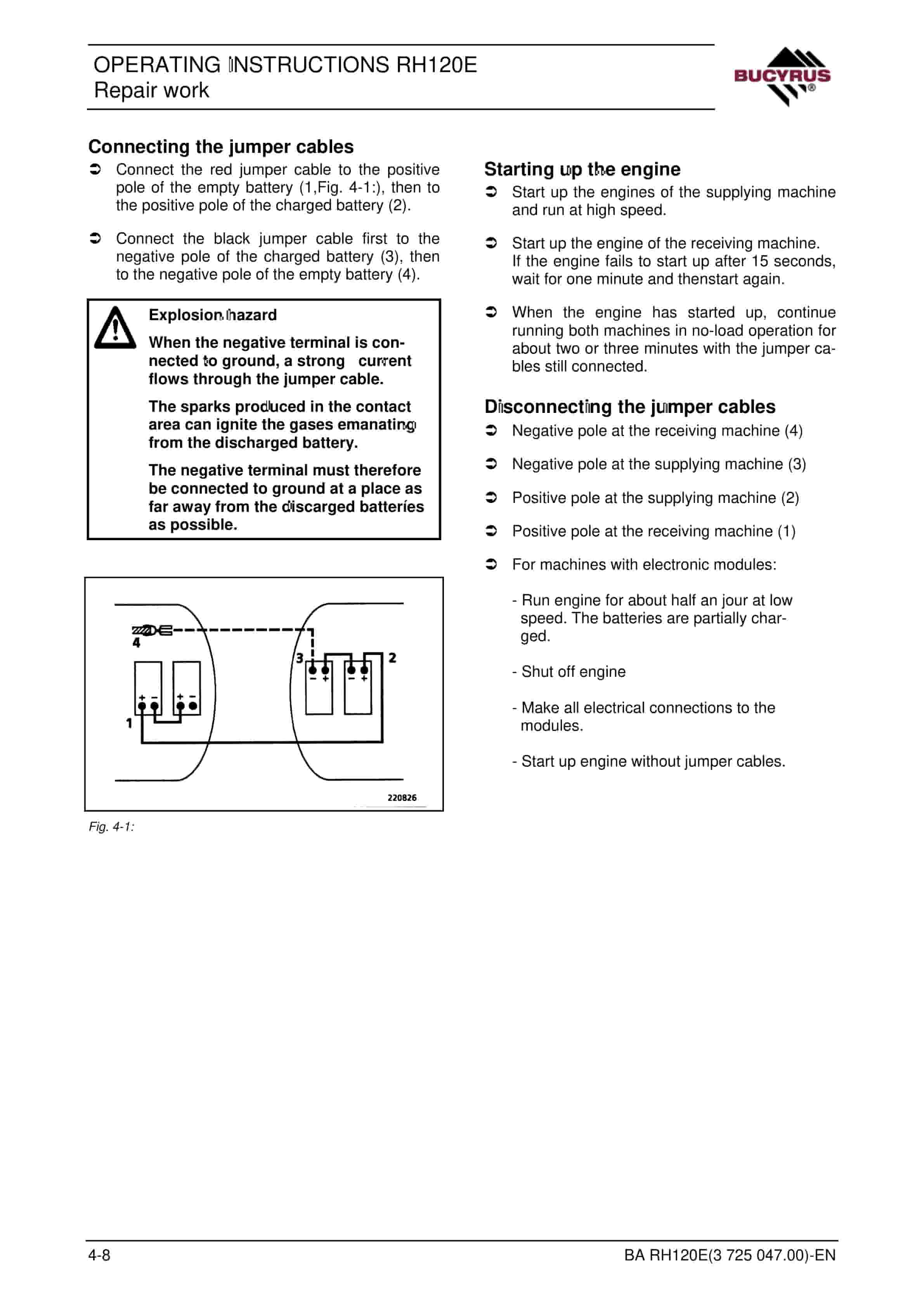
- 5.4.3. Starting the engine with jumper cables (external batteries
- 5.5. HYDRAULIC SYSTEM
- 5.5.1. Repair instructions
- 5.5.2. Hydraulic hoses Instructions
- 5.6. PRESSURE ACCUMULATORS – SAFETY INSTRUCTIONS
- 5.7. WELDING OPERATIONS – SAFETY INSTRUCTIONS
- 5.8. DISPOSAL AT THE END OF THE SERVICE LIFE
- 5.8.1. Dismantling and removal instructions
- 5.8.2. Risk of deflagrations
- 5.8.3. Risk of fire
- 5.8.4. Disposing of the machine without polluting the environment
- 5.8.5. Further hazardous substances
- 5.8.6. Appropriate disposal of batteries
- 6. ANNEX
- 6.1. BOARD-CONTROL-SYSTEM
- 6.1.1. BCS III, whats that
- 6.1.2. The keys on the front side
- 6.1.3. Other elements on the front side
- 6.1.4. BCSIII, the start screen
- 6.1.5. Information given on the start screen, top section
- 6.1.6. Information given on the start screen, central section
- 6.1.7. Information given on the start screen, lower section
- 6.1.8. Information given on the Service screen
- 6.1.9. Engine data screen
- 6.1.10. Hydraulic data screen
- 6.1.11. Lubrication data screen
- 6.1.12. Controls adjustment data screen
- 6.1.13. View documents screen
- 6.1.14. Signal table screen
- 6.1.15. Signal table screen, location
- 6.1.16. Signal table screen, diagram
- 6.1.17. Signal table screen, diagram configuration
- 6.1.18. Code table screen
- 6.1.19. BCS III, interfaces
- 6.1.20. USB interface, data storage
- 6.1.21. Saving data to a USB stick
- 6.1.22. Saving data to a USB stick, continued
- 6.1.23. Saving data to a USB stick, continued
- 6.1.24. BCSIII, cleaning
- 6.1.25. BCSIII, disposal
- 6.2. TROUBLESHOOTING
- 6.2.1. Instructions on troubleshooting
- 6.2.2. Layout of the fault table
- 6.2.3. Possible causes
- 6.2.4. Measures
- 6.2.5. Section
- 6.3. FAULT TABLES
- 6.3.1. Combustion engine – Fault table
- 6.3.2. Working hydraulics Fault table
- 6.3.3. Track drive Fault table
- 6.3.4. Swing mechnism Fault table
- 6.3.5. Central lubricating system Fault table
- 6.4. ENGINE MONITORING, CONTROL LAMPS
- 6.5. HYDRAULIC CIRCUIT DIAGRAM
- 6.6. ABBREVIATIONS
- 6.6.1. ABBREVIATIONS
- 6.7. TECHNICAL DATA
- 6.7.1. Product_Specification_Sheet.pdf
- 7. INDEX
Related products
-

Bucyrus 151-M Shovel And Dragline Technical Manual BI006254
$30.00 Add to cart -

Bucyrus 1370W Walking Dragline Technical Manual BI005556
$30.00 Add to cart -

Bucyrus 110B Shovel And Dragline Technical Manual BI005553
$30.00 Add to cart -

Bucyrus 1030 China Technical Manual BI000839
$30.00 Add to cart -

Bucyrus 151-M Technical Manual BI005612
$30.00 Add to cart


