

Caterpillar 6060AC Hydraulic Excavator Operating Instructions 3725092
$30.00
- Type Of Manual: Operating Instructions
- Manual ID: 3725092
- Number of Pages: 266
- Size: 7.3MB
- Format: PDF
Product details
-
Model List:
- 6060AC Hydraulic Excavator
- 1. TITLEPAGE
- 2. INTRODUCTION
- 2.1. PREFACE
- 2.2. WARRANTY
- 2.3. FUNDAMENTAL SAFETY INSTRUCTIONS
- 2.3.1. Warnings and symbols
- 2.4. DESIGNATED USE
- 2.5. ORGANIZATIONAL MEASURES
- 2.5.1. Selection and qualification of personnel basic responsibilities
- 2.5.2. Safety instructions governing specific operational phases
- 2.5.3. Special work in conjunction with utilization of the machine and maintenance and repairs as well as troubleshooting during work disposal of parts and consumables
- 2.5.4. Warning of special dangers
- 2.5.5. Gas, dust, steam and smoke
- 2.5.6. Hydraulic / pneumatc equipment
- 2.5.7. Oil, grease and other chemical substances
- 2.5.8. Transporting and recommissioning
- 2.6. ACCIDENT PREVENTION REGULATIONS FOR ELECTRICALLY POWERED EXCAVATORS
- 2.6.1. Safety instructions for excavators with electric motor
- 2.7. FIRE AND EXPLOSION HAZARD
- 3. OPERATION
- 3.1. OPERATION – SAFETY INSTRUCTIONS
- 3.1.1. Operating Instructions, where to store it in the drivers cab
- 3.2. FIRE AND EXPLOSION HAZARD
- 3.3. DESCRIPTION OF THE EXCAVATOR
- 3.3.1. Excavator layout
- 3.3.2. Undercarriage
- 3.3.3. Superstructure
- 3.3.4. Hydraulic system
- 3.3.5. Pump Managing System (PMS)
- 3.3.6. Programmable Logic Controller (PLC)
- 3.3.7. Control Management System (CMS)
- 3.3.8. Demand control / Zero-flow regulation
- 3.3.9. Board-Control-System (BCS)
- 3.3.10. Electrical system
- 3.3.11. Power supply
- 3.3.12. Operation with cable reel (optional)
- 3.3.13. Entering and leaving the machine Safety instructions
- 3.3.14. Ramp-type ladder
- 3.3.15. Swinging ladder (optional)
- 3.3.16. Escape ladder
- 3.3.17. Cab interior lamp
- 3.3.18. Servicing lighting
- 3.3.19. Illuminating the control column
- 3.3.20. EMERGENCY STOP switch
- 3.3.21. Servicing switch
- 3.3.22. Windscreen washer
- 3.3.23. Drivers seat
- 3.3.24. Fire extinguisher
- 3.3.25. Automatic fire-extinguishing system (optional)
- 3.3.26. Trainers / instructors seat
- 3.3.27. Emergency escape device (optional)
- 3.4. MONITORING, WARNING AND CONTROL ELEMENTS
- 3.5. PUTTING THE MACHINE INTO OPERATION
- 3.5.1. Service station (tanklift)
- 3.5.2. Battery main switch, switching on and off
- 3.5.3. Electrical system (24V), switching on and off
- 3.5.4. Switching the electric motor on and off
- 3.5.5. Time-out before restart
- 3.5.6. Electric motor can not be switched on
- 3.5.7. In case of failure
- 3.5.8. Circuit breaker, switching on and off
- 3.5.9. Motor protection relay, functions
- 3.5.10. Warm-up procedure for electric excavators
- 3.5.11. Air conditioner (option)
- 3.6. TRAVELLING, SAFETY INSTRUCTIONS
- 3.7. TRAVELLING
- 3.7.1. Superstructure basic position
- 3.7.2. Travelling forwards/backwards
- 3.7.3. Superstructure holding brake
- 3.7.4. Track parking brake
- 3.8. TRANSPORTING THE MACHINE
- 3.8.1. Transport – Safety instructions
- 3.9. WORKING OPERATION – SAFETY INSTRUCTIONS
- 3.10. WORKING OPERATION
- 3.10.1. Before starting work
- 3.10.2. Swinging the superstructure
- 3.10.3. Braking the superstructure
- 3.10.4. Working
- 3.10.5. Emergency lowering of the working equipment
- 3.10.6. After daily operation
- 3.11. ASSEMBLING WORKING EQUIPMENT – SAFETY INSTRUCTIONS
- 3.11.1. Securing the machine
- 3.12. CORROSION PROTECTION FOR PINS AND BEARINGS (BUSHINGS AND HUBS)
- 3.13. NOTES
- 4. INSPECTION AND SERVICING
- 4.1. SAFETY INSTRUCTIONS FOR EXCAVATORS WITH ELECTRIC MOTOR
- 4.2. INSPECTION AND SERVICING – SAFETY INSTRUCTIONS
- 4.3. FIRE AND EXPLOSION HAZARD
- 4.4. INSPECTION AND SERVICING PLANS – INSTRUCTIONS
- 4.4.1. Intervals
- 4.4.2. Oils / Greases
- 4.4.3. Cleaning jobs
- 4.4.4. Components
- 4.4.5. Plan V
- 4.4.6. Plan N
- 4.4.7. Plan T and W
- 4.4.8. Plan A E
- 4.5. LUBRICATING CHART GREASE
- 4.5.1. Lubricating chart Grease (legend)
- 4.5.2. Filling quantities Grease
- 4.6. INSPECTION PLAN – OIL
- 4.6.1. Inspection plan Oil (legend)
- 4.6.2. Filling quantities – oil
- 4.6.3. Filling quantities – other
- 4.7. LUBRICANTS
- 4.7.1. Notes on the selection of oils and greases
- 4.7.2. Avoid mixing of different hydraulic fluids
- 4.8. LUBRICANTS
- 4.8.1. Oils for combustion engines (On-Board Crane, option)
- 4.8.2. II. Oils for hydraulic system (selection)
- 4.8.3. III.a Oils for pump gearboxes
- 4.8.4. III.b Oils for swing gearboxes
- 4.8.5. III.c Oils for drive gearboxes
- 4.8.6. Greases for bearings and swing rings
- 4.9. SERVICING WORK
- 4.9.1. Hose line for oil changes
- 4.10. ELECTRIC MOTOR
- 4.10.1. Electric motor – Safety instructions
- 4.10.2. Cleaning the electric motor
- 4.10.3. Electric motor, greasing
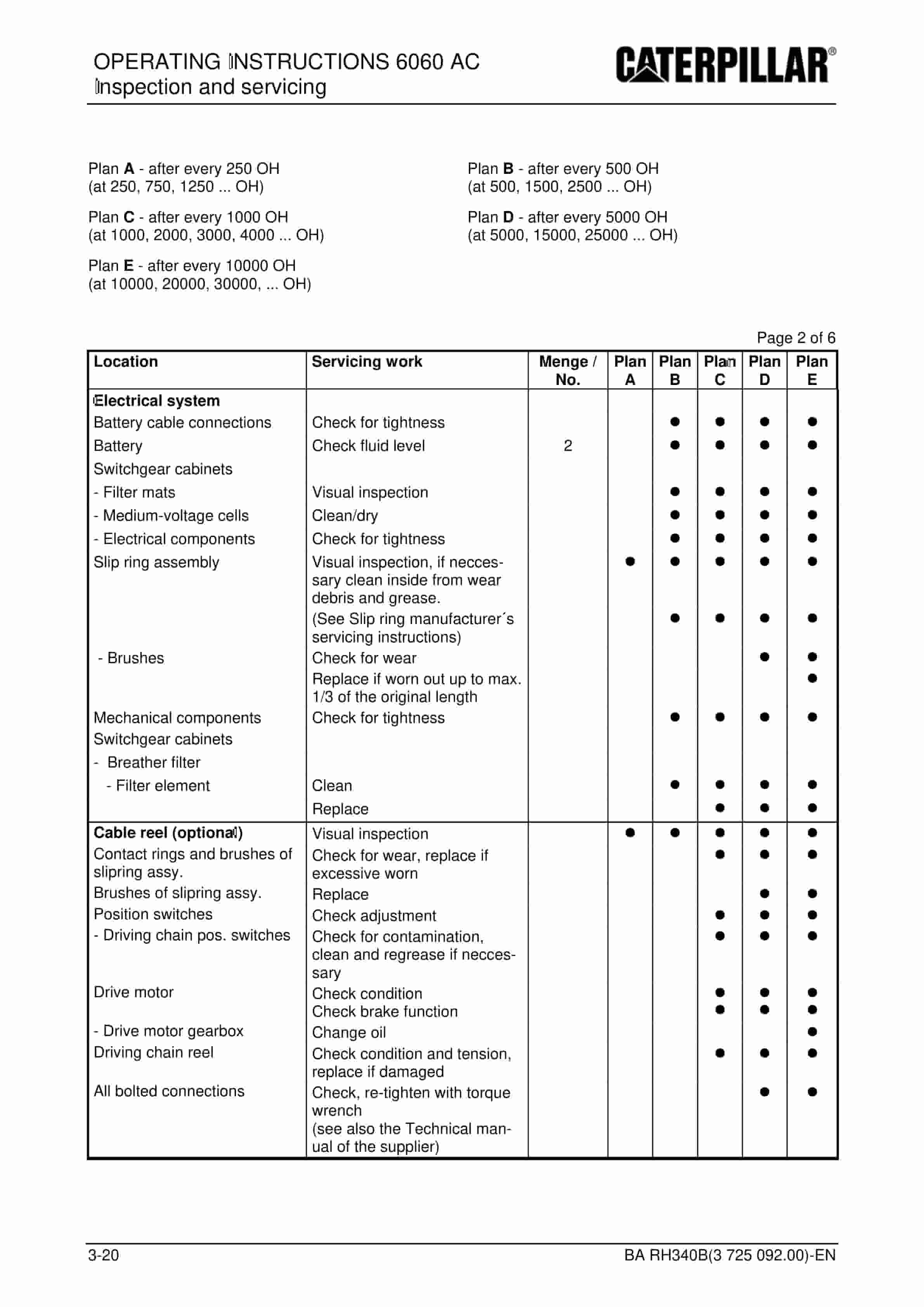
- 4.11. ELECTRICAL SYSTEM
- 4.11.1. Electrical system – Safety instructions
- 4.11.2. Battery
- 4.11.3. Control cabinets
- 4.11.4. Slip ring assembly, servicing work
- 4.11.5. Floodlight projector, replacing the lamp
- 4.11.6. Lighting systems in LED technonogy, instructions
- 4.12. HYDRAULIC SYSTEM
- 4.12.1. Hydraulic system – Safety instructions
- 4.12.2. Depressurizing the hydraulic system
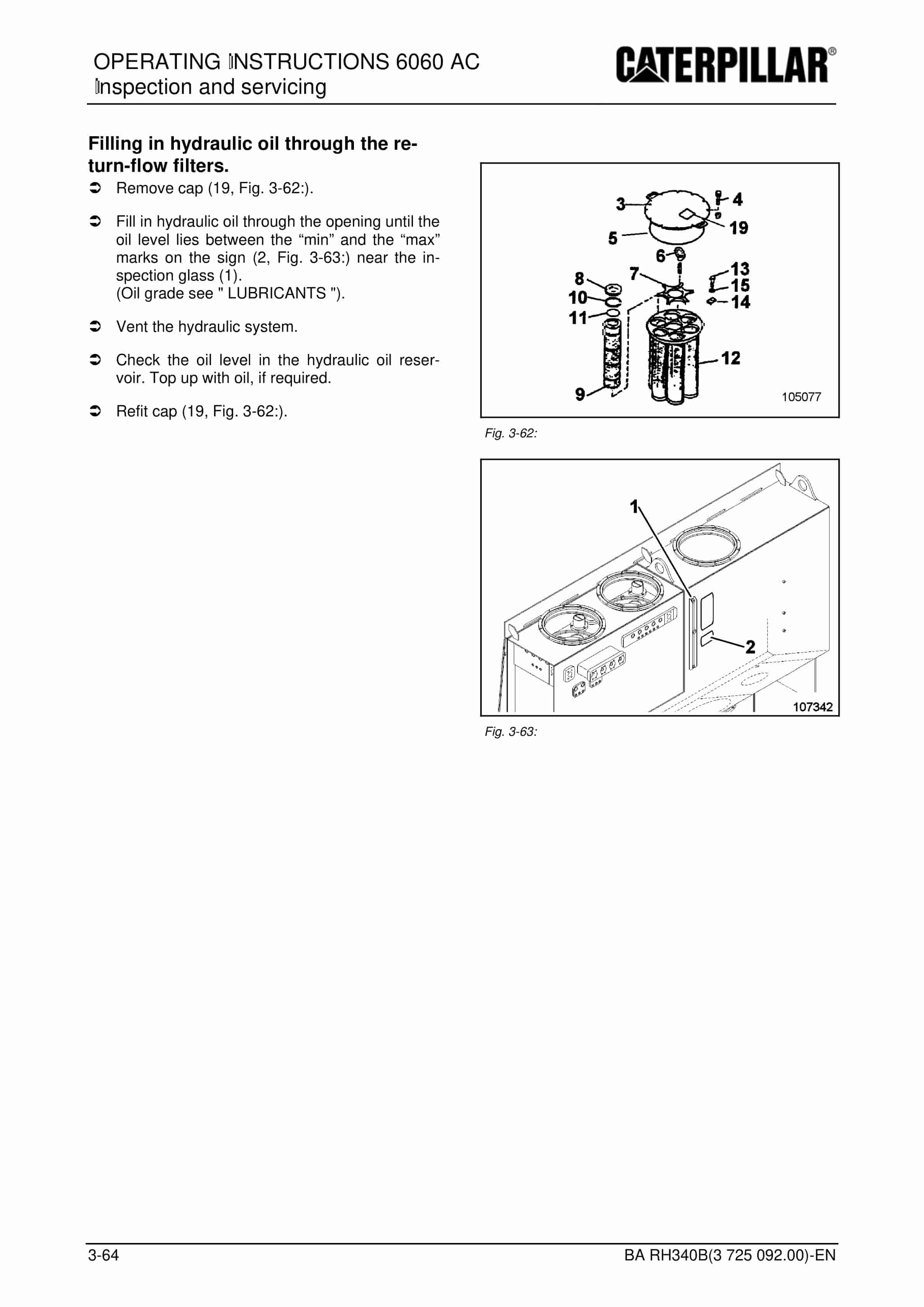
- 4.12.3. Checking the hydraulic oil level
- 4.12.4. Changing the hydraulic oil return-flow filter (hydraulic oil reservoir)
- 4.12.5. Bypass valves (hydraulic oil reservoir)
- 4.12.6. Breather filter
- 4.12.7. Filter (servo control circuit), replace
- 4.12.8. High-pressure filter for working hydraulics, replace
- 4.12.9. Filters for swing charge pump, replace
- 4.12.10. Bearing flushing of the main pumps, filter replacement Bearing flushing of the main pumps, filter replacement
- 4.12.11. Changing the hydraulic oil
- 4.12.12. Venting the hydraulic system
- 4.12.13. Cleaning the hydraulic oil cooler
- 4.12.14. Electronic excavator control
- 4.12.15. Pressure accumulator – Emergency lowering
- 4.13. PUMP TRANSFER GEARBOX
- 4.13.1. Pump gearbox, checking oil level / Topping up with oil
- 4.13.2. Pump gearbox, pre-chamber
- 4.13.3. Pump gearbox, venting
- 4.13.4. Pre-chambers working pumps, draining oil, changing oil
- 4.13.5. Pre-chambers swing pumps, draining oil, changing oil
- 4.13.6. Pump gearbox, oil filter
- 4.14. SWING GEARBOX
- 4.14.1. Swing gearbox – Checking the oil level / Topping up with oil
- 4.14.2. Changing the gearbox oil
- 4.14.3. Swing gearbox, venting ,
- 4.15. TRAVEL GEARBOX (GEARBOX P/N 3683483)
- 4.15.1. Travel gearbox – Checking the oil level / Topping up with oil
- 4.15.2. Travel gearbox – Changing oil
- 4.15.3. Travel gearbox – Breather filter
- 4.16. TRAVEL GEARBOX(GEARBOX P/N 3683496)
- 4.16.1. Travel gearbox – Checking the oil level / Topping up with oil
- 4.16.2. Travel gearbox – Changing oil
- 4.16.3. Travel gearbox -Breather filter
- 4.17. CRAWLER TRACKS
- 4.17.1. Track rollers
- 4.17.2. Track tensioner
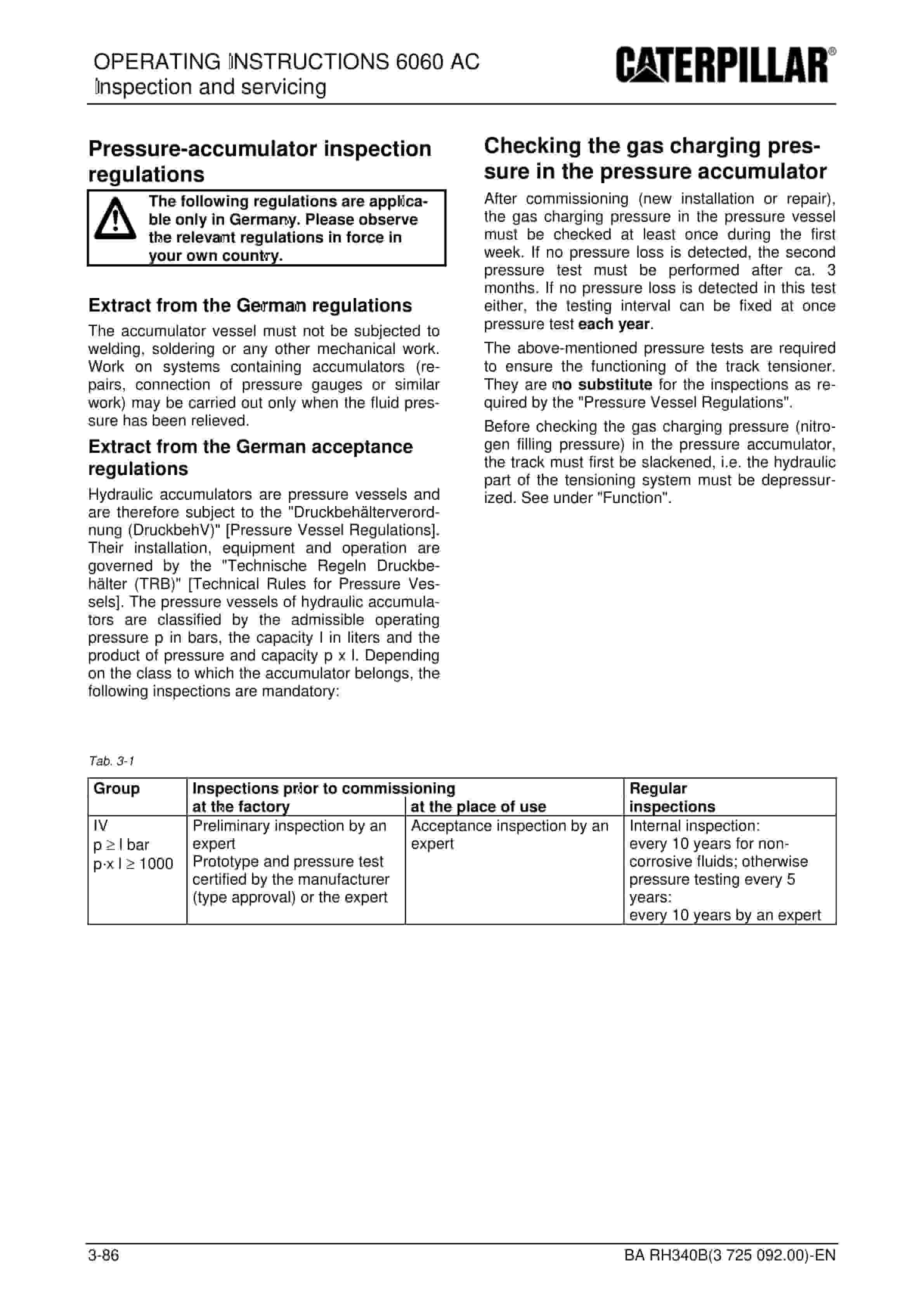
- 4.17.3. Pressure-accumulator inspection regulations
- 4.17.4. Checking the gas charging pressure in the pressure accumulator
- 4.18. SWING RING
- 4.18.1. Swing ring – Instructions
- 4.18.2. Bearing races
- 4.19. CENTRAL LUBRICATING
- 4.19.1. Design and function
- 4.19.2. Function
- 4.19.3. Filling up the grease container
- 4.19.4. Breather filter
- 4.19.5. Checking the greasing pressure
- 4.19.6. Checking the greasing pressure
- 4.19.7. Unblocking a grease line.
- 4.19.8. Unblocking a grease line.
- 4.19.9. Oilfilter (hydraulic circuit grease pump) )
- 4.19.10. Grease filter (Filling the grease container)
- 4.19.11. Grease filter (Grease lines)
- 4.20. OTHER MAINTENANCE
- 4.20.1. Heating and air conditioning
- 4.20.2. Equipment, check for cracks
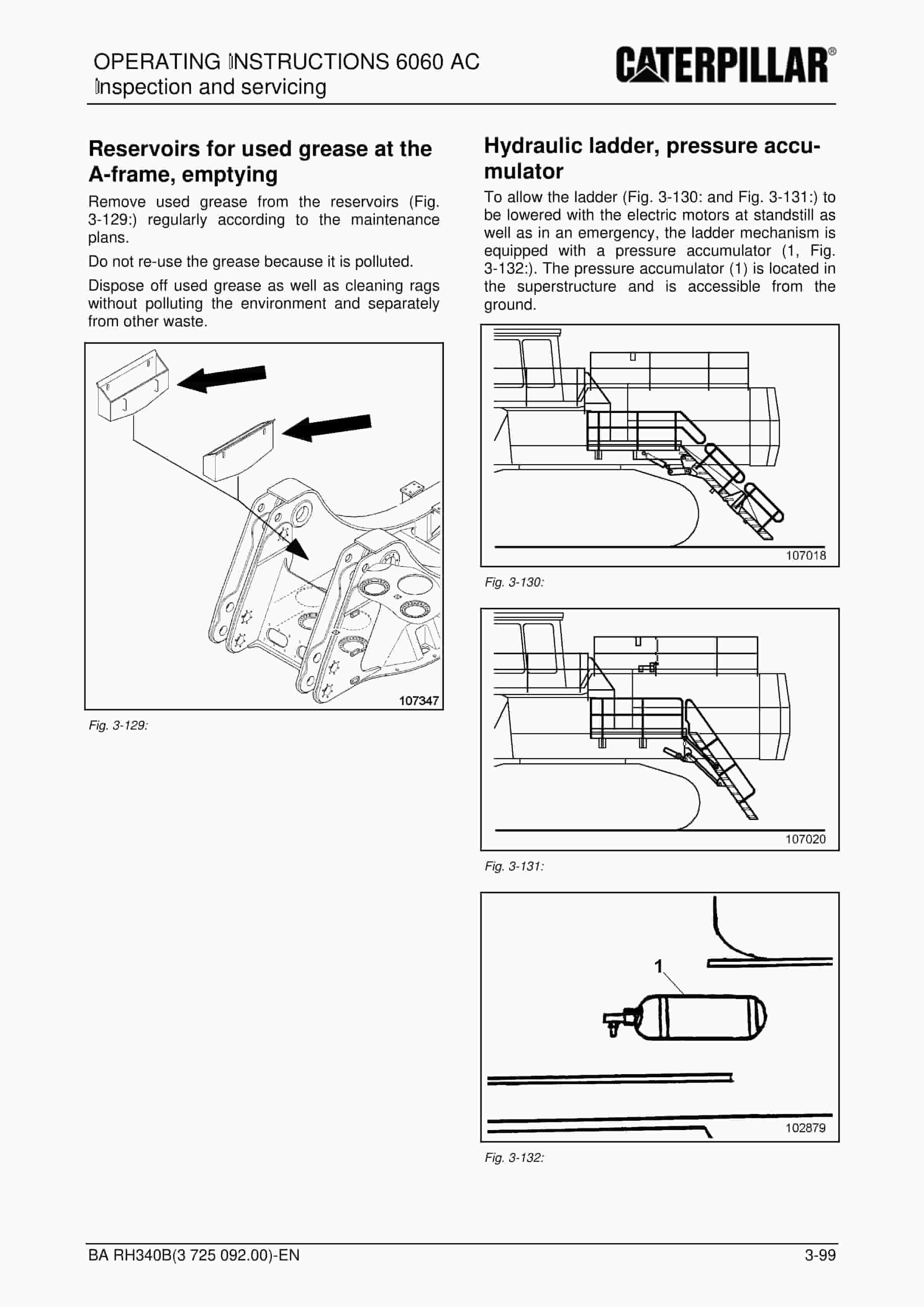
- 4.20.3. Reservoirs for used grease at the A-frame, emptying
- 4.20.4. Hydraulic ladder, pressure accumulator
- 4.20.5. Pressure-accumulator inspection regulations
- 4.20.6. Extract from the regulations
- 4.20.7. Checking the gas charging pressure in the pressure accumulator
- 4.21. ON-BOARD CRANE (OPTIONAL)
- 4.21.1. Crane, monitoring, warning and control elements
- 4.21.2. Checking the on-board crane
- 4.21.3. Crane, drive unit
- 4.21.4. On-board crane, servicing
- 4.21.5. On-Board crane, checking tightness of fastening bolts
- 4.22. PUTTING THE EXCAVATOR OUT OF OPERATION AND RECOMMISSIONING
- 4.22.1. Putting the excavator out of operation
- 4.22.2. Battery storage
- 4.22.3. Recommissioning
- 5. REPAIR WORK
- 5.1. SAFETY INSTRUCTIONS FOR EXCAVATORS WITH ELECTRIC MOTOR
- 5.2. REPAIR WORK – SAFETY INSTRUCTIONS
- 5.3. FIRE AND EXPLOSION HAZARD
- 5.4. HYDRAULIC SYSTEM
- 5.4.1. Repair
- 5.4.2. Hydraulic hoses Instructions
- 5.5. PRESSURE ACCUMULATORS – SAFETY INSTRUCTIONS
- 5.6. WELDING AND FLAME CUTTING WORKS – SAFETY INSTRUCTIONS
- 5.7. DISPOSAL AT THE END OF THE SERVICE LIFE
- 5.7.1. Appropriate disposal of batteries
- 6. ANNEX
- 6.1. TROUBLESHOOTING
- 6.1.1. Instructions on troubleshooting
- 6.1.2. Layout of the fault table
- 6.1.3. Possible causes
- 6.1.4. Measures
- 6.1.5. Section
- 6.2. FAULT TABLES
- 6.2.1. Working hydraulics Fault table
- 6.2.2. Track drive Fault table
- 6.2.3. Swing mechnism Fault table
- 6.2.4. Central lubricating system Fault table
- 6.3. HYDRAULIC CIRCUIT DIAGRAM
- 6.4. ABBREVIATIONS
- 6.5. TECHNICAL DATA
- 6.5.1. Product Specification Sheet
- 6.6. NOTES
- 7. INDEX
Related products
-

Caterpillar Cervis Remote Control Operation Operation Manual BI001581
$30.00 Add to cart -

Caterpillar CM340 Continuous Miner Operation And Maintenance Manual BI001584-01
$30.00 Add to cart -

Caterpillar BSL PF 6-1542 Operating Manual 0010 458 600 BA 00
$30.00 Add to cart -

Caterpillar CM235 Continuous Miner Operation And Maintenance Manual A6474X454
$30.00 Add to cart -

Caterpillar CM345-N Continuous Miner Operation And Maintenance Manual BI001588
$30.00 Add to cart


