

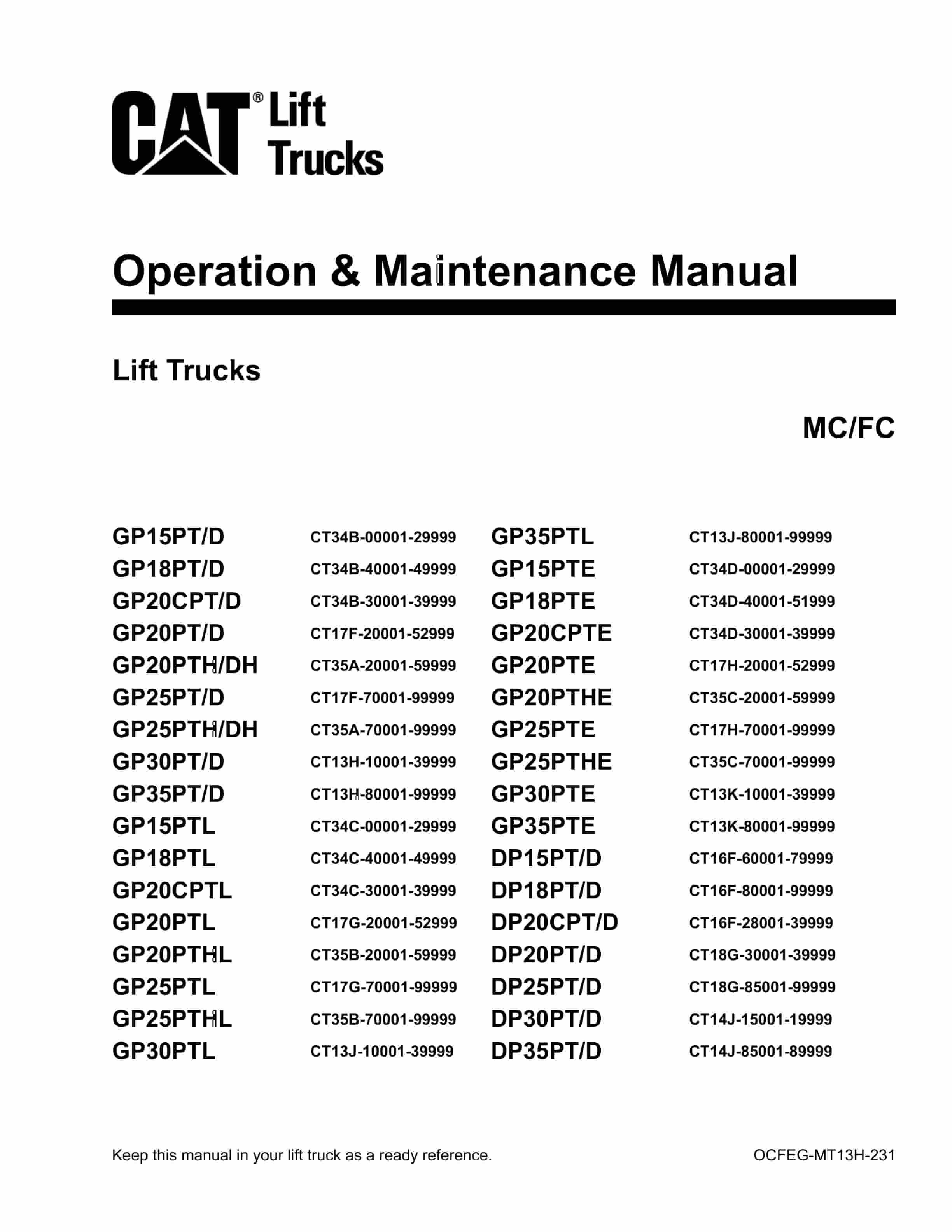
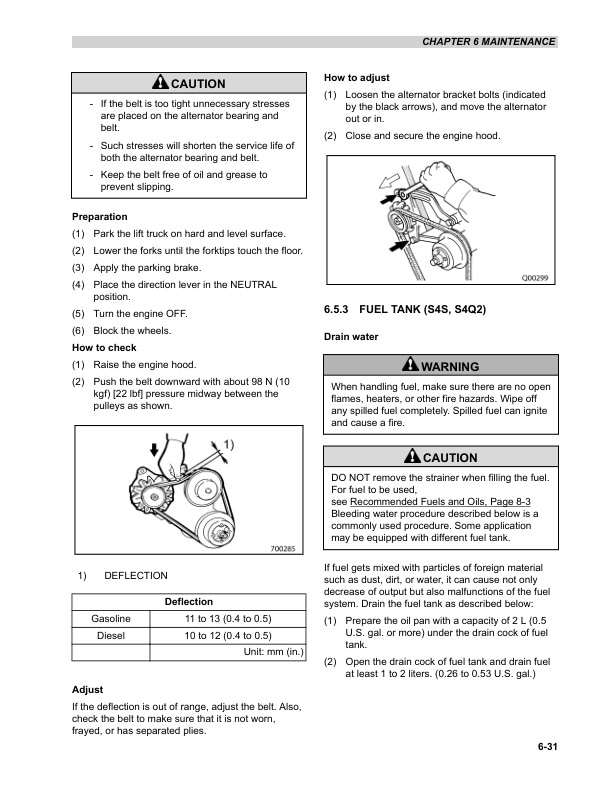
Caterpillar GP15-35PT-PTD-PTL-PTE, DP15-35PT-D Lift Trucks Operation and Maintenance Manual OCFEG-MT13H-231
$30.00
- Type Of Manual: Operation and Maintenance Manual
- Manual ID: OCFEG-MT13H-231
- Number of Pages: 308
- Size: 19.0MB
- Format: PDF
Product details
-
Model List:
- GP15PT, GP15PTD, GP15PTL, GP15PTE, GP18PT, GP18PTD, GP18PTL, GP18PTE, GP20CPT, GP20CPTD, GP20CPTL, GP20CPTE, GP20PT, GP20PTD, GP20PTL, GP20PTE, GP20PTH, GP20PTHDH, GP20PTHL, GP20PTHE, GP25PT, GP25PTD, GP25PTL, GP25PTE, GP25PTH, GP25PTHDH, GP25PTHL, GP25PTHE, GP30PT, GP30PTD, GP30PTL, GP30PTE, GP35PT, GP35PTD, GP35PTL, GP35PTE, DP15PT, DP15PTD, DP18PT, DP18PTD, DP20CPT, DP20CPTD, DP20PT, DP20PTD, DP25PT, DP25PTD, DP30PT, DP30PTD, DP35PT, DP35PTD
- 1. FOREWORD
- 2. CHANGE LOG
- 3. CHAPTER 1 IMPORTANT NOTIFICATION
- 3.1. General
- 3.1.1. How To Use This Manual
- 3.1.2. Models Covered in this Manual
- 3.1.3. LOCKOUT/TAGOUT
- 3.1.4. PRODUCT REGISTRATION
- 3.2. Warning Decals, Location
- 3.2.1. Warning Decals, Location
- 3.3. Description of Danger, Warning, and Caution Decals
- 3.3.1. Survive in Tip Over Decal
- 3.3.2. Parking Brake Decal
- 3.3.3. Fasten Seat Belt Decal
- 3.3.4. No Riders Warning Decal
- 3.3.5. Back-up Alarm Decal
- 3.3.6. Operation Warning Decal
- 3.3.7. Radiator Cap Warning Decal
- 3.3.8. No Access With Engine Running Decal
- 3.3.9. No One Under / On Forks and No One Between Mast and Lift Truck Decal
- 3.3.10. Load Backrest Extension Decal
- 3.3.11. Crush and Pinch Point Decal
- 3.3.12. Capacity Plate
- 3.3.13. Inspection / Lubrication Chart (For Latin America)
- 3.3.14. Gasoline / LPG Changeover Decal
- 3.3.15. Operator Restraint System Decal
- 3.3.16. Operate with OMM Decal
- 3.3.17. Deflate Air Before Loosening Nut Decal
- 3.3.18. No Contamination Permissible Decal
- 3.3.19. Hoist Point Decal (Mast)
- 3.3.20. Hoist Point Decal (Counterweight) (Except LPG)
- 3.3.21. Laser Light Decal (For Laser Fork Height Pointer, Option)
- 3.3.22. Clamp Release Decal (Double Action) (Option)
- 4. CHAPTER 2 SAFETY RULES
- 4.1. General
- 4.1.1. General
- 4.1.2. Authorized and Trained Operators Only
- 4.1.3. Lift Trucks Are NOT Intended to Use on Public Roads
- 4.1.4. Operator Responsibility
- 4.1.5. Know the Lift Truck and Attachments
- 4.1.6. Maintain Adequate Clearance, Crushing Hazard
- 4.1.7. Qualifications Required for Slinging Work
- 4.1.8. Have the Operators Receive Safety Education for Load Stacking Work
- 4.1.9. Education for New Lift Truck
- 4.1.10. Refresher Training for the Experieced Operators
- 4.1.11. Know All Signals and Traffic Rules
- 4.1.12. Developing Safe Work Plans
- 4.1.13. Operate the Lift Truck Safely Within the Rules and Regulations of Your Employer
- 4.1.14. Be Familiar with Traffic Zones and Operating Routes
- 4.1.15. Adhere to Speed Limits
- 4.1.16. Designate a Spotter for Blind Spots
- 4.1.17. Always Be Alert
- 4.1.18. Confirming Emergency Contact Methods
- 4.1.19. Dress Properly for the Job
- 4.1.20. DO NOT Operate the Lift Truck If You Are Pregnant or Have Suffered an Abdominal Disease or Injury
- 4.1.21. Daily Pre-start Inspection
- 4.1.22. Ensure the Lift Truck and Attachment Equipped Are Appropriate for the Job
- 4.1.23. Keep Out
- 4.1.24. Watch Out for Personnel
- 4.1.25. BEWARE of Personnel Working Near the Lift Truck Operation
- 4.1.26. Watch Out for Pedestrians at All Times
- 4.2. Fire Hazards
- 4.2.1. No Smoking While Refueling
- 4.2.2. No Smoking During Fueling and Battery Charging
- 4.2.3. Caution on Smoking in the Operator Compartment
- 4.2.4. Check for Any Source of Potential Fire Hazard
- 4.2.5. Check for Oil Leaks
- 4.2.6. Short Circuit Inspection
- 4.2.7. LP-Gases Are Flammable
- 4.2.8. Fire Evacuation Procedures
- 4.2.9. Exhaust Fumes Could Kill You
- 4.3. Inspection Maintenance
- 4.3.1. Inspect the Lift Truck Before Operation
- 4.3.2. Unauthorized Addition or Modification Is Prohibited
- 4.3.3. Qualified Technicians for Lift Truck Repair and Attachment Work
- 4.3.4. Authorized and Trained Operators Only
- 4.3.5. Turn OFF the Key Switch Before Servicing
- 4.3.6. Lower the Forks to the Ground Before Servicing
- 4.3.7. Take Fall Prevention Measures for the Forks and Mast When Checking or Maintenance with the Forks Raised
- 4.3.8. DO NOT Put Your Foot Under Forks
- 4.3.9. Caution on Jack-up Work
- 4.3.10. Caution Prior on Lift Truck Lifting Work
- 4.3.11. DO NOT Get Your Hand Caught in the Floor Plate and Engine Hood
- 4.3.12. Avoid Being Splashed by Scalding Hot Coolant
- 4.3.13. Perform the Engine Maintenance When the Engine Is Stopped and Has Cooled Down
- 4.3.14. Caution with Hot Oil Spraying at High Hydraulic Oil Temperatures
- 4.3.15. Inspecting Accumulators and Their Piping Can Be Hazardous
- 4.3.16. Check the Rotating Parts with the Engine Stopped
- 4.3.17. Proper Maintenance of Brake Fluid Is Critical to Brake Performance
- 4.3.18. Caution on Handling the Long-Life Coolant (LLC)
- 4.3.19. Keep the Operator Compartment Clean
- 4.3.20. Wipe Off Dirt, Oil and Grease Immediately
- 4.3.21. Dispose of Potentially Hazards Materials (e.g., Oils, Solvents, Engine Coolant, Batteries, etc.,) in Accordance with Applicable Laws and Regulations
- 4.3.22. DO NOT Remove the Overhead Guard
- 4.3.23. DO NOT OVERLY RELY ON OVERHEAD GUARDS
- 4.3.24. DO NOT Remove, or Disable, Safety Devices or Features (e.g., Overhead Guard, Load Backrest, Horn etc.)
- 4.3.25. Be Careful of Falling Off
- 4.3.26. DO NOT Substitute the Mast for a Ladder
- 4.3.27. DO NOT Start the Engine by Pushing or Pulling the Lift Truck
- 4.3.28. Caution When Adjusting the Air Pressure of the Tires (Rim and Compressor)
- 4.3.29. Caution on Handling Tire Mounting Nuts, Rims and Rim Mounting Bolts/Nuts
- 4.3.30. Precautions When Handling Controllers and Sensors
- 4.4. Pre-start/Before Getting on
- 4.4.1. Know Your Lift Truck Is Safe
- 4.4.2. Inspect the Lift Truck Before Operation
- 4.4.3. Make a Habit of Performing the Daily Pre-start Inspection
- 4.4.4. Performing and Recording the Periodic Check is Mandatory
- 4.4.5. Critical Safety Parts Must Be Replaced Periodically
- 4.4.6. DO NOT Operate a Damaged or Defective Lift Truck
- 4.4.7. DO NOT Operate an Unsafe Lift Truck
- 4.4.8. DO NOT Operate the Lift Truck Under the Influence of Drugs or Alcohol
- 4.4.9. Position Levers Correctly for Starting
- 4.4.10. Sit in the Operator Seat When Starting the Engine and Operating the Operation Levers
- 4.5. Getting on – Before Driving
- 4.5.1. Face the Lift Truck During Ingress and Egress (Getting On and Off)
- 4.5.2. Three-point Contact
- 4.5.3. Adjust the Operator Seat Before Operating the Lift Truck
- 4.5.4. When Operating the Lift Truck, BE SURE to Fasten the Seat Belt
- 4.5.5. THE BACK-UP ALARM MUST ACTIVATE WHEN TRAVELING IN REVERSE
- 4.5.6. If There Is Any Abnormality with the Rear-view Mirrors, Back-up Alarm, Lights, and Horn, Have Them Repaired Immediately.
- 4.5.7. DO NOT Allow Any Riders
- 4.5.8. DO NOT Allow Anyone to Ride on Counterweight and Carry Any Passenger
- 4.5.9. Caution When Starting the Lift Truck
- 4.5.10. Make Sure Your Lift Truck Is in a Safe Operating Condition
- 4.5.11. Make Sure That No One Is Around the Lift Truck Before Starting
- 4.5.12. ALWAYS Be Aware of People Near Your Lift Truck
- 4.6. Know Your Working Area
- 4.6.1. Operate Only in Approved Areas
- 4.6.2. Always Check Overhead Clearance
- 4.6.3. Ensure Necessary Brightness for Safe Operation
- 4.6.4. Always Be Aware of Floor and Ground Capacity
- 4.6.5. Surface and Capacity (for CushionTire Models)
- 4.6.6. Check Work Places for High Risk
- 4.6.7. Trailer and Railroad Car Safety
- 4.6.8. Dock Plates (Bridge Plates) Safety
- 4.6.9. Operating in Elevators Safely
- 4.7. Driving/Traveling
- 4.7.1. Stay Under the Overhead Guard and Within the Confines of the Lift Truck
- 4.7.2. DO NOT Hold on to the Overhead Guard
- 4.7.3. DO NOT Jump Out of the Lift Truck in the Event of Tip Over
- 4.7.4. In Case of Tip over
- 4.7.5. Obey All Traffic Regulations and Warning Signs, Including Authorized Plant Speed Limits
- 4.7.6. DO NOT Overtake Another Lift Truck
- 4.7.7. Slow Down on Wet and Slippery Surfaces
- 4.7.8. Slow Down Where Vision Is Obstructed
- 4.7.9. DO NOT Indulge in Stunt Driving or Horseplay
- 4.7.10. Be Careful When Turning with a Load
- 4.7.11. DO NOT Speed When Making Turns
- 4.7.12. Always Look in the Direction of Travel
- 4.7.13. No Distracted Driving
- 4.7.14. Drive with Awareness of Surroundings
- 4.7.15. Travel in REVERSE If Forward Visibility Is Blocked
- 4.7.16. Be Careful of Drive End Swing
- 4.7.17. Allow for Tail Swing Distance
- 4.7.18. DO NOT Run Over Objects
- 4.7.19. Travel Safely on Grades with a Loaded Lift Truck
- 4.7.20. Travel Safely on Grades with an Empty Lift Truck
- 4.7.21. Be Particularly Careful When Driving Up or Down Asteep Slope
- 4.7.22. Slow Down at the Top of Upgrades
- 4.7.23. Starting the Lift Truck on an Upgrade Carefully
- 4.7.24. ALWAYS Descend a Grade Carefully
- 4.7.25. Adjust the Operation of the Lift Truck So That You Can Descend Safely
- 4.7.26. DO NOT Turn on Grades or Ramps
- 4.7.27. DO NOT Operate the Lift Truck with a Load Under Windy Conditions
- 4.7.28. DO NOT Operate the Parking Brake Lever During Travel
- 4.8. Load Handling
- 4.8.1. STAY CLEAR OF CRUSH AND PINCH POINTS
- 4.8.2. Check Fork Locking Pins for Engagement
- 4.8.3. Ensure Equal Tension in Both the Left and Right Lift Chains
- 4.8.4. Be Careful of Changes in Capacity
- 4.8.5. Always Stay Within the Capacity
- 4.8.6. DO NOT Lift Personnel Except on a Securely Attached, Specially Designed Work Platform
- 4.8.7. Precautions During Load Handling
- 4.8.8. DO NOT Allow Anyone to Hold Loads
- 4.8.9. DO NOT Allow Unloading from Raised Loads
- 4.8.10. Use the Proper Attachment
- 4.8.11. Side Shift Operation
- 4.8.12. Fork Positioner Operation
- 4.8.13. DO NOT Raise or Lower a Load While Side Shifting
- 4.8.14. DO NOT Use Damaged Pallets
- 4.8.15. DO NOT Speed When Approaching Loads
- 4.8.16. Operate the Direction Lever Smoothly
- 4.8.17. Avoid Off-center Loading
- 4.8.18. Be Careful of Forks That Extend Beyond the Load
- 4.8.19. Handle Only Stable and Safely Arranged Loads
- 4.8.20. Ensure the Load Isnt Too High
- 4.8.21. Falling Object Hazard
- 4.8.22. Ensure Stable Stacking of Loads
- 4.8.23. DO NOT Abuse Forks
- 4.8.24. DO NOT Use the Lift Truck Improperly
- 4.9. Stopping/Parking
- 4.9.1. Park in Authorized Areas Only
- 4.9.2. Park Disabled Lift Truck Safely
- 4.9.3. DO NOT Park on a Grade.
- 4.9.4. SET THE PARKING BRAKE PROPERLY
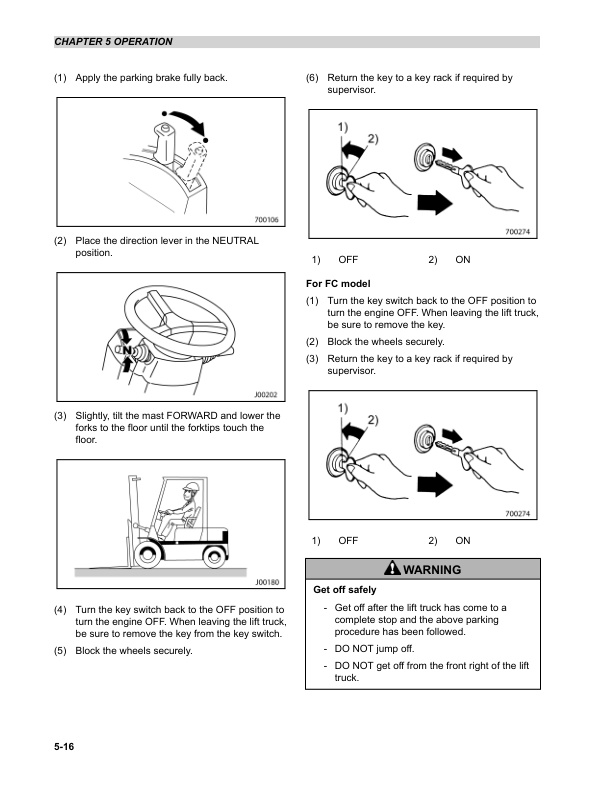
- 4.9.5. When You Leave or Park the Lift Truck
- 4.10. Handling of Battery Charger
- 4.10.1. Wear Protective Gear When Handling of Battery
- 4.10.2. Flush the Contact Area with Large Amounts of Water Immediately When Come Into Contact with Battery Electrolytes
- 4.10.3. Flammables and Fire Should Be Kept Away From the Battery
- 4.10.4. Keep Tools and Metal Parts Away From the Battery to Avoid Short Circuit
- 4.10.5. Caution When Handling of Battery Terminals
- 4.10.6. Caution When Using the Jumper Cables to Start
- 4.10.7. Caution When Handling of Charger
- 4.10.8. Caution During Battery Charging
- 4.10.9. DO NOT Short Circuit Both Battery Terminals to Check the Battery Charging Status
- 4.10.10. Caution on Static Electricity When Checking or Cleaning the Battery
- 4.10.11. Caution on Battery Voltage
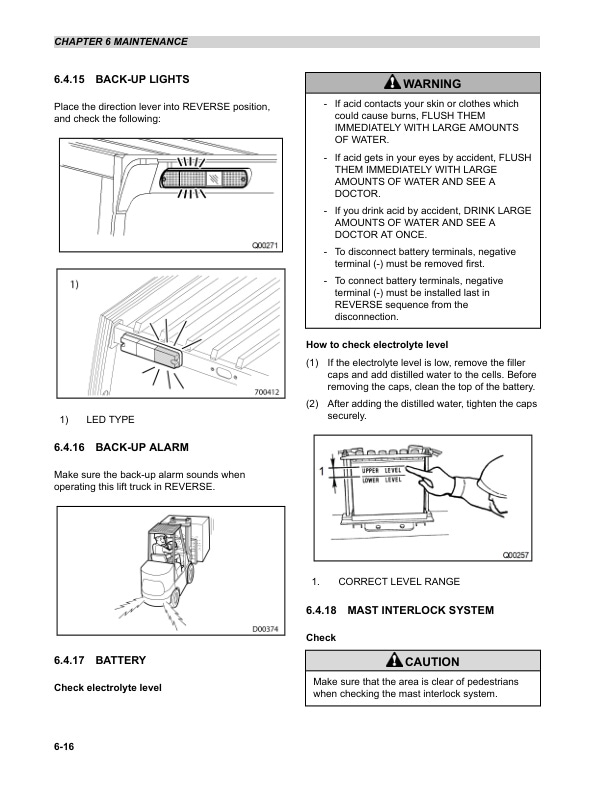
- 4.10.12. Caution on Electrolyte Level
- 4.11. Handling of Fuel LPG Cylinder (Tank)
- 4.11.1. Fuel Handling
- 4.11.2. CAUTION ON HANDLING LPG CYLINDERS (TANKS)
- 4.12. Lift Truck Loading and Shipping (Transportation)
- 4.12.1. Lift Truck Loading and Shipping
- 4.13. Towing Your Lift Truck
- 4.13.1. DRAWBAR PIN
- 4.14. Lifting Your Lift Truck
- 4.14.1. LIFTING YOUR LIFT TRUCK
- 5. CHAPTER 3 HOW TO AVOID A TIP OVER
- 5.1. Know What Lift Truck Stability Is
- 5.1.1. Know What Lift Truck Stability Is
- 5.2. Center of Gravity (CG)
- 5.2.1. Center of Gravity (CG)
- 5.3. Stability and Center of Gravity
- 5.3.1. Stability and Center of Gravity
- 5.4. Lift Truck Stability Base
- 5.4.1. Lift Truck Stability Base
- 5.5. Capacity (Weight and Load Center)
- 5.5.1. Capacity (Weight and Load Center)
- 5.6. Capacity Plate
- 5.6.1. Capacity Plate – Overview
- 5.6.2. For Example
- 5.6.3. Nominal Capacity Height Indicator
- 5.7. Dos and Donts to Avoid Tip Over
- 5.7.1. Dos and Donts to Avoid Tip Over
- 5.8. How to Survive in a Tip Over
- 5.8.1. How to Survive in a Tip Over
- 6. CHAPTER 4 KNOW YOUR LIFT TRUCK
- 6.1. Serial Number and Capacity Plate
- 6.1.1. Serial Number and Capacity Plate
- 6.2. Electrical Components
- 6.2.1. Electrical Components
- 6.3. Model View
- 6.3.1. Model View – Overview
- 6.3.2. MC Model
- 6.3.3. FC Model
- 6.4. Driving Switches and Controls
- 6.4.1. Driving Switches and Controls – Overview
- 6.4.2. Key Switch
- 6.4.3. Direction Lever (Powershift)
- 6.4.4. Inching Pedal (Powershift)
- 6.4.5. Turn Signal / Light Switch
- 6.4.6. Steering Column Tilt Lever
- 6.5. Meter Panel
- 6.5.1. Meter Panel Parts Description
- 6.5.2. Button
- 6.5.3. LCD Screen Display Switching
- 6.5.4. LCD Screen
- 6.5.5. Warning Icons and Indicators
- 6.5.6. Basic Operation
- 6.5.7. When Diagnostic Code Is Shown on Display
- 6.5.8. Warning Symbols
- 6.5.9. Optional Features
- 6.6. Presence Detection System
- 6.6.1. Presence Detection System (PDS) – Overview
- 6.6.2. Mast Interlock System
- 6.6.3. Mast Interlock System Functions
- 6.6.4. Driving Interlock System (Powershift Models)
- 6.6.5. Driving Interlock System Functions
- 6.6.6. Neutral System
- 6.6.7. Neutral System Functions
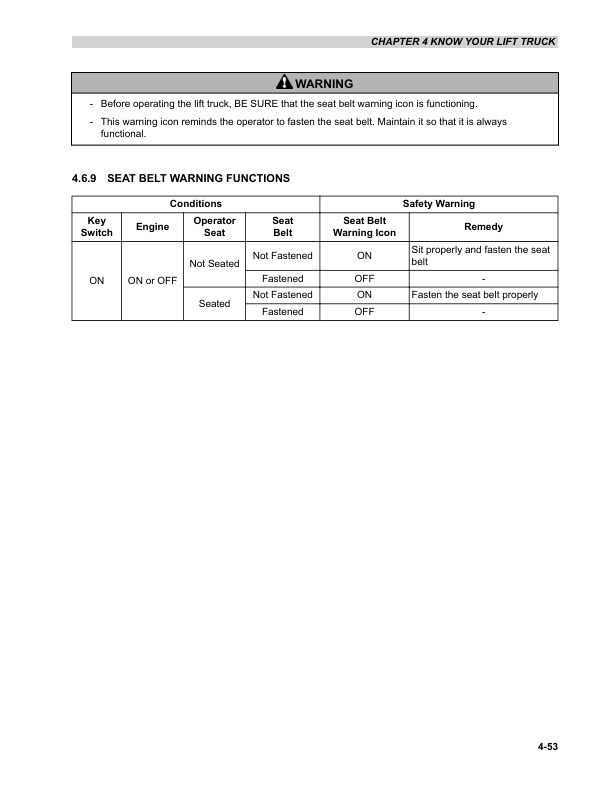
- 6.6.8. Seat Belt Warning Icon
- 6.6.9. Seat Belt Warning Functions
- 6.6.10. Parking Brake Warning Icon and Alarm
- 6.6.11. Parking Brake Warning Functions
- 6.6.12. Seatbelt Interlock (Standard for Australia Specification and Option for Other Destinations)
- 6.6.13. Seat Belt Interlock System Functions
Related products
-
Caterpillar 3.3 Liter (4.2032) Diesel Engine Disassembly and Assembly SENB8128
$30.00 Add to cart -
Caterpillar AOS EP-CB, NRS-CB1, EP-TCB Lift Trucks Operation and Maintenance Manual OCFEM-J0AOS-200
$30.00 Add to cart -

Caterpillar 2.0 Liter (XN1P) Gasoline Engine Specifications Systems Operation Testing and Adjusting SENB8237-04
$30.00 Add to cart -
Caterpillar DP100NL-160SNL Lift Trucks Operation and Maintenance Manual OCFEG-J091K-213
$30.00 Add to cart -
Caterpillar DP100NM1, DP120NM1, DP135NM1, DP150NM1 Operation and Maintenance Manual 99790-67100
$30.00 Add to cart
%20Diesel%20Engine%20Disassembly%20and%20Assembly%20SENB8128&url=https://ownersmanualpdf.net/docs/caterpillar-3-3-liter-4-2032-diesel-engine-disassembly-and-assembly-senb8128/&media=https://ownersmanualpdf.net/wp-content/uploads/2025/10/caterpillar-33-liter-42032-diesel-engine-disassembly-and-assembly-senb8128-1.jpg)

%20Gasoline%20Engine%20Specifications%20Systems%20Operation%20Testing%20and%20Adjusting%20SENB8237-04&url=https://ownersmanualpdf.net/docs/caterpillar-2-0-liter-xn1p-gasoline-engine-specifications-systems-operation-testing-and-adjusting-senb8237-04/&media=https://ownersmanualpdf.net/wp-content/uploads/2025/10/caterpillar-20-liter-xn1p-gasoline-engine-specifications-systems-operation-testing-and-adjusting-senb8237-04-1.jpg)

