

Mitsubishi FBC22N2 to FBC30LN2 Operation and Maintenance Manual 99750-7N100
$30.00
- Type Of Manual: Operation and Maintenance Manual
- Manual ID: 99750-7N100
- Number of Pages: 196
- Size: 13.3MB
- Format: PDF
Product details
-
Model List:
- FBC22N2, FBC25N2, FBC25EN2, FBC25LN2, FBC30N2, FBC30LN2
- 1. FOREWORD
- 1.1. How to Use This Manual
- 1.1.1. Truck Models Covered in This Manual
- 2. SAFETY RULES FOR
- 2.1. General
- 2.2. Location
- 2.3. Decals, Description
- 2.3.1. Fasten Seat Belt Decal
- 2.3.2. Survive in a Tipover Decal
- 2.3.3. Danger Electric
- 2.3.4. Overhead Guard
- 2.3.5. Operation Warning Decal
- 2.3.6. Fuse Warning
- 2.3.7. Parking Brake Adjustment Decal
- 2.3.8. No One under / on Forks / Pinch Points
- 2.3.9. Crush and Pinch Points
- 2.3.10. With Backrest Extension
- 2.3.11. No Riders Decal
- 2.3.12. Back-up Alarm Decal
- 2.3.13. Capacity Plate
- 2.3.14. Designated Tire Type
- 2.4. Safety Rules
- 2.5. Operating Precautions
- 2.6. Working Precautions
- 3. KNOW YOUR
- 3.1. Serial Number and Capacity Plate
- 3.2. Electrical Components
- 3.2.1. Controller
- 3.3. Model View
- 3.4. Driving Switches and Controls
- 3.4.1. Key Switch
- 3.4.2. Direction Lever
- 3.4.3. Light Switch
- 3.4.4. Steering Column Tilt Lever
- 3.5. Meter Panel
- 3.5.1. Configuration of Meter Panel
- 3.5.2. Meter Panel Screen Transition
- 3.5.3. Diagnostic Code
- 3.5.4. Password Entry
- 3.5.5. User Setting Function
- 3.5.6. Mast Interlock System
- 3.5.7. Driving Interlock System
- 3.5.8. Controlled Rollback Function
- 3.5.9. Neutral Lock
- 3.5.10. Seat Belt Warning
- 3.5.11. Parking Brake Warning Buzzer
- 3.6. Parking Brake Warning Buzzer and Icon
- 3.7. Operating Switches and Controls (MC Model)
- 3.7.1. Lift Lever
- 3.7.2. Tilt Lever
- 3.7.3. Attachment Lever
- 3.8. Operator Seat
- 3.8.1. Seat Adjustment
- 3.8.2. Forward and Back Adjustment
- 3.8.3. How To Tip the Seat Forward
- 3.8.4. Pocket for the Manual
- 3.8.5. Operator Presence Switch and Buzzer
- 3.9. Seat Belt
- 3.10. Fork Locking Pins
- 3.11. Changing Forks
- 3.12. Assist Grip
- 3.13. Battery Cover
- 3.14. Hydraulic Tank Oil Level / Filler Hole
- 3.15. Brake Reservoir Tank Fluid Level
- 4. HOW TO AVOID A TIPOVER HOW TO SURVIVE ONE
- 4.1. Know What
- 4.2. Center of Gravity (CG)
- 4.3. Stability and Center of Gravity (Top View)
- 4.4. Stability and Center of Gravity (Side View)
- 4.5. Truck Stability Base
- 4.6. Capacity (Weight and Load Center)
- 4.7. Capacity Plate
- 4.8. Dos and Donts to Avoid Tipover
- 4.9. How to Survive in a Tipover
- 5. OPERATION
- 5.1. Before Starting
- 5.1.1. Starting
- 5.1.2. Mast Interlock System
- 5.1.3. Seat Adjustment
- 5.2. Before Moving
- 5.3. Truck Operation
- 5.3.1. Changing Speed
- 5.3.2. Changing Direction
- 5.3.3. Operating Techniques
- 5.3.4. Steering (Turning)
- 5.4. Stopping
- 5.5. Parking
- 5.6. Leaving
- 6. OPERATING TECHNIQUES
- 6.1. Stacking Methods
- 6.1.1. Stacking Different Size Loads
- 6.1.2. Stacking Small Identical Loads
- 6.1.3. Stacking Large Identical Loads
- 6.2. Handling Loads Safely
- 6.3. Flickering of the Interlock Indicator Icons
- 6.4. Lifting the Load
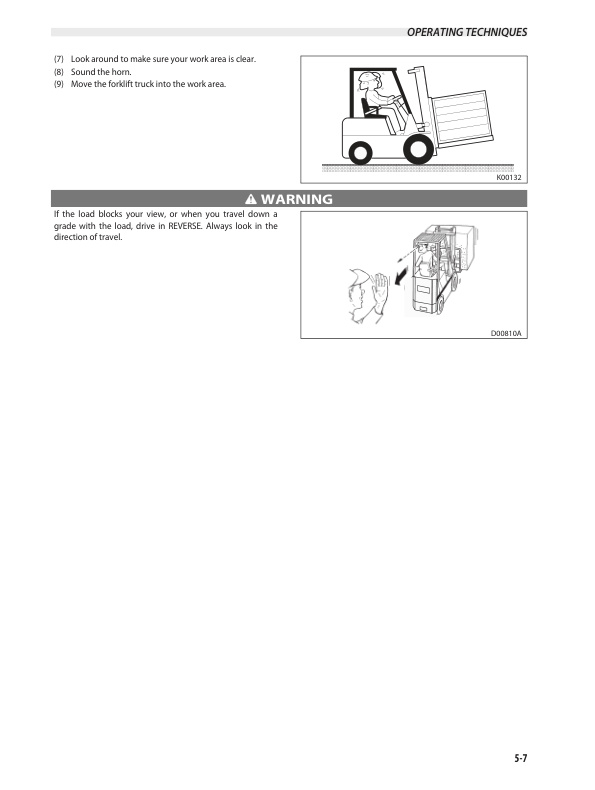
- 6.5. Traveling with the Load
- 6.6. Unloading
- 6.7. Working on Grades
- 6.7.1. Normal Travel Position
- 6.7.2. Traveling on a Grade
- 6.7.3. Stopping on a Grade
- 7. STORING THE
- 7.1. End of Each Shift Storage
- 7.2. Long Term Storage
- 7.2.1. Hydraulic System
- 7.2.2. Battery
- 7.2.3. Controller
- 8. TRANSPORTATIONS HINTS
- 8.1. Truck Loading and Shipping
- 8.2. Truck Lifting and Tie Down Information
- 9. SPECIAL SITUATIONS
- 9.1. Care in Cold Weather
- 9.1.1. Battery
- 9.2. Care in Hot Weather
- 9.2.1. Battery
- 10. TROUBLESHOOTING
- 10.1. Fuses and Lights
- 10.1.1. How to Check Fuses and Lights
- 10.2. Diagnostic Code List
- 11. MAINTENANCE
- 11.1. General
- 11.2. Inspection Precautions
- 11.3. Maintenance Schedule
- 11.3.1. Every 10 Service Hours or Daily (Pre-Start), Whichever Comes First
- 11.3.2. Every 50 Service Hours or Weekly, Whichever Comes First
- 11.3.3. One Month (30 days) or 200 Service Hours After Delivery of a New Truck, Whichever Comes First
- 11.3.4. Every 500 Service Hours or 3 Months, Whichever Comes First
- 11.3.5. Every 1000 Service Hours or 6 Months, Whichever Comes First
- 11.3.6. Every 2000 Service Hours or 1 year, Whichever Comes First
- 11.4. Every 10 Service Hours or Daily (Pre-Start), Whichever Comes First
- 11.4.1. Faulty Operation Found the Day Before
- 11.4.2. Battery Electrolyte
- 11.4.3. Battery Charge Level
- 11.4.4. Key Switch
- 11.4.5. Oil or Battery Electrolyte Leaks
- 11.4.6. Accelerator Pedal
- 11.4.7. Tires and Rims
- 11.4.8. Steering Wheel and Steering Column
- 11.4.9. Wheel Nuts
- 11.4.10. Brake Pedal
- 11.4.11. Brake Fluid Level
- 11.4.12. Parking Brake Lever
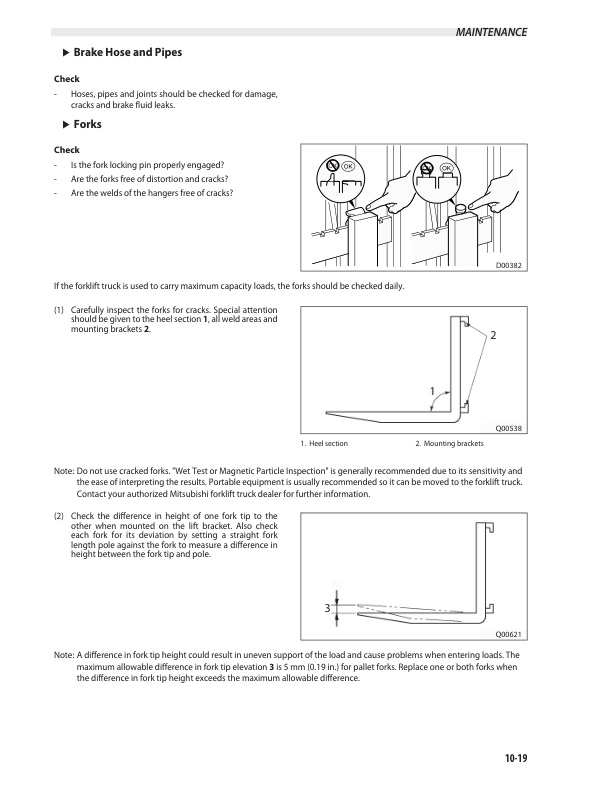
- 11.4.13. Brake Hose and Pipes
- 11.4.14. Outer and Inner Masts
- 11.4.15. Tilt Cylinder and Masts
- 11.4.16. Outer Masts and Cylinder Support
- 11.4.17. Lift Bracket
- 11.4.18. Lift Cylinder Mounting Bolts
- 11.4.19. Lift Bracket Main Rollers and Side Rollers
- 11.4.20. Mast Strip Sliding Surfaces and Rollers
- 11.4.21. Tilt Cylinder Socket Bolts
- 11.4.22. Mast Support
- 11.4.23. Lift Chains
- 11.4.24. Load Backrest Extension, Lift Bracket
- 11.4.25. Cylinders (Lift Cylinders, Tilt Cylinders, and Steer Cylinder)
- 11.4.26. Oil Pump
- 11.4.27. Operation Levers
- 11.4.28. Control Valves
- 11.4.29. Hydraulic Oil
- 11.4.30. Hydraulic Hoses, Pipes, and Joints
- 11.4.31. Overhead Guard
- 11.4.32. Assist Grip
- 11.4.33. Front Lights and Rear Working Light (If equipped)
- 11.4.34. Meter Panel
- 11.4.35. Operator Seat
- 11.4.36. Seat Belt
- 11.4.37. Mast Interlock System
- 11.4.38. Driving Interlock System
- 11.4.39. Driving Control System (Traction Motors, Steering System and Brake System)
- 11.5. Every 50 Service Hours or Weekly, Whichever Comes First
- 11.5.1. Battery Electrolyte Specific Gravity
- 11.6. One Month (30 days) or 200 Service Hours After Delivery of a New Truck, Whichever Comes First
- 11.6.1. Rear Axle Mounting Bushing
- 11.6.2. Rear Axle King Pins
- 11.6.3. Rear Axle Tie Rod Pins
- 11.6.4. Lift Bracket Main Roller and Side Rollers
- 11.6.5. Mast Strip Sliding Surfaces and Rollers
- 11.6.6. Mast Support
- 11.6.7. Tilt Cylinder End
- 11.7. Every 500 Service Hours or 3 Months, Whichever Comes First
- 11.7.1. Differential
- 11.8. Every 1000 Service Hours or 6 Months, Whichever Comes First
- 11.8.1. Wheel Bearings
- 11.8.2. Mast Supports
- 11.8.3. Tilt Sockets
- 11.8.4. Chain Wheel
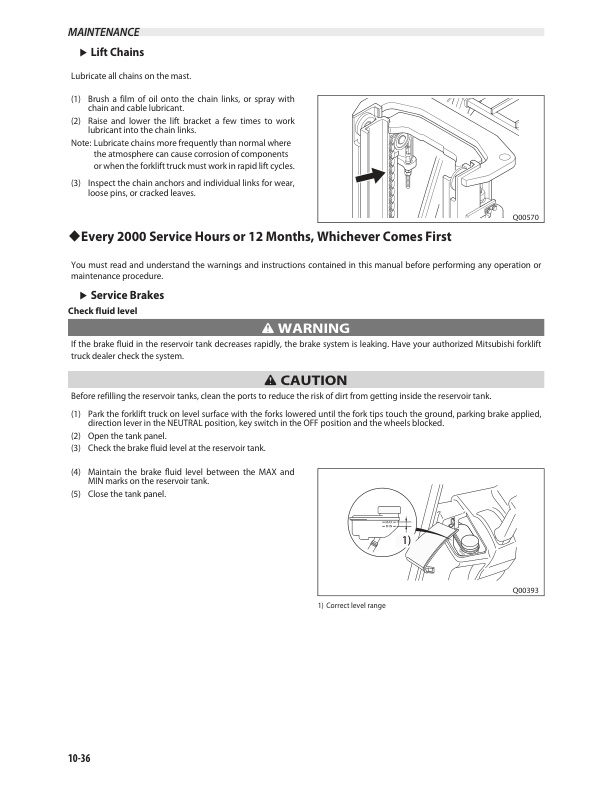
- 11.8.5. Lift Chains
- 11.9. Every 2000 Service Hours or 12 Months, Whichever Comes First
- 11.9.1. Service Brakes
- 11.9.2. Hydraulic Oil
- 11.9.3. Hydraulic System
- 11.10. Parts to Be Changed Periodically
- 12. SERVICE DATA
- 12.1. Recommended Oils and Greases
- 12.2. Specifications (Standard Models)
- 12.3. Capacities and
- 13. TO THE
- 13.1. The Importance of Genuine Parts
- 13.2. Proper Disposal of Your
- 13.3. Instructions for Ordering Parts
- 13.4. Service Registration
- 13.5. Transfer of Ownership Report for
- 14. APPENDIX
- 14.1. Description of Circuit Diagrams
- 14.1.1. Schematic diagram
- 14.1.2. Connector Diagrams
- 14.2. How to Read Circuit Diagrams
- 14.2.1. Symbols
- 14.2.2. Sheet Symbol
- 14.2.3. Connecting Lines
- 14.2.4. Equipment
- 14.2.5. Relay Contactor and Coil
- 14.2.6. Connectors
- 14.2.7. Indication of Connecting Line
- 14.2.8. Indication of GND (Earth)
- 14.2.9. Indication of Another Specification
- 14.3. How to Read Connector Diagrams
- 14.4. Circuit Diagram
Related products
-
Mitsubishi FB10CB-35CB, FB20-25LCB Forklift Trucks Operation and Maintenance Manual OMFEM-M22C0-200
$30.00 Add to cart -
Mitsubishi FB14-20A(C)NT, FB16-20A(C)N Operation and Maintenance Manual 654390 EN A
$30.00 Add to cart -
Mitsubishi EOP15N, EOP15HN Operation and Maintenance Manual 99750-7L120
$30.00 Add to cart -
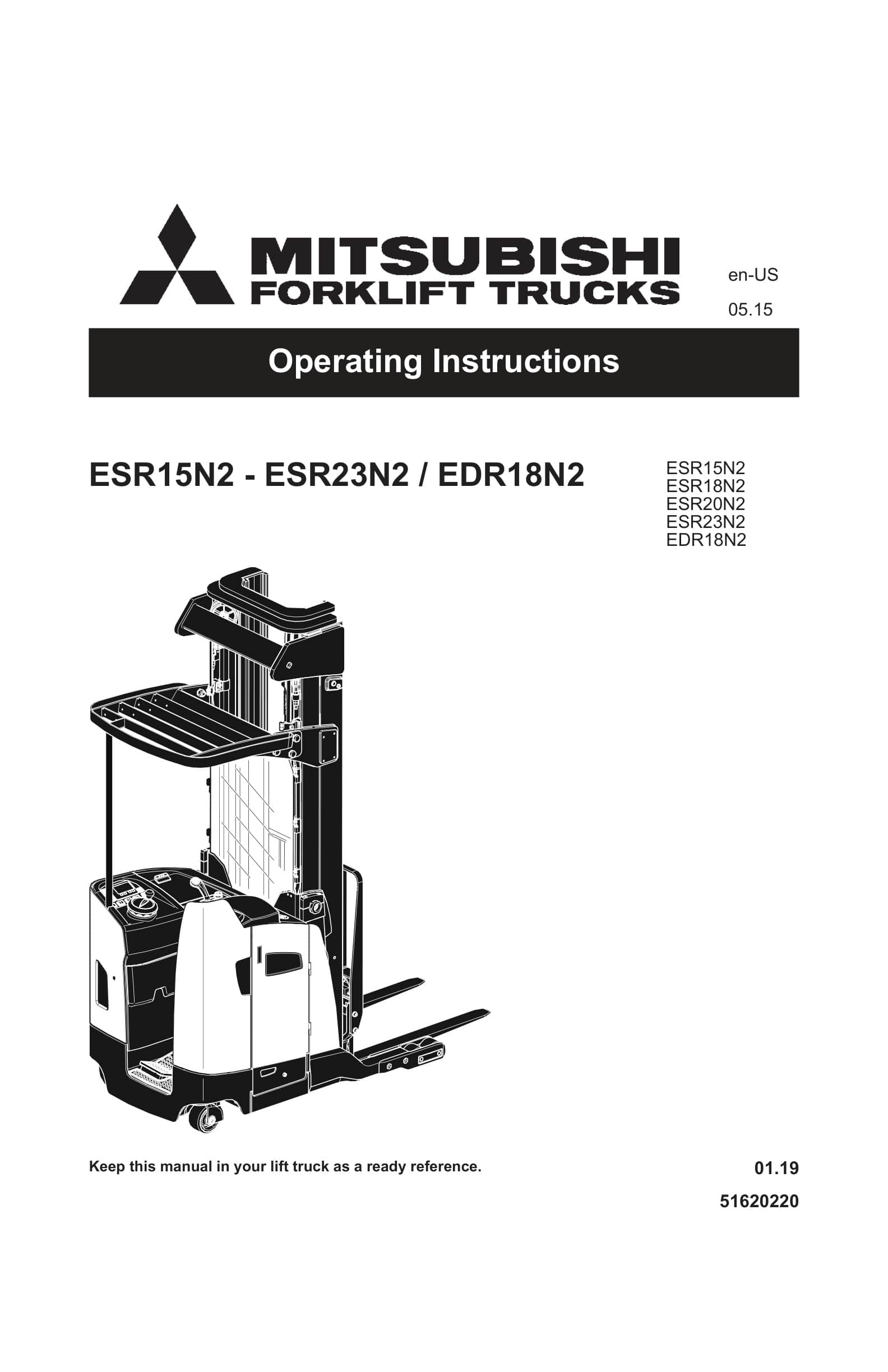
Mitsubishi ESR15N2-ESR23N2, EDR18N2 Operating Instructions 51620220
$30.00 Add to cart -
Mitsubishi FB13-20TCB, FB16-20TBCB Operation and Maintenance Manual 99750-27100
$30.00 Add to cart

NT,%20FB16-20A(C)N%20Operation%20and%20Maintenance%20Manual%20654390%20EN%20A&url=https://ownersmanualpdf.net/docs/mitsubishi-fb14-20acnt-fb16-20acn-operation-and-maintenance-manual-654390-en-a/&media=https://ownersmanualpdf.net/wp-content/uploads/2025/10/mitsubishi-fb14-20acnt-fb16-20acn-operation-and-maintenance-manual-654390-en-a-1.jpg)


